





The Fayetteville Ale Trail Puts the Spotlight on 24 Breweries in Northwest Arkansas
Journey to the region and discover local craft beverage culture as presented by Experience Fayetteville and its passport program.
 Story by:
Brian Sorenson
Story by:
Brian Sorenson
There is a large concentration of breweries in the hills of Northwest Arkansas. About one-half of the state’s beermakers call the region home. This tight cluster of craft breweries makes it convenient for people intent on seeing them all; and many do see them all, often as a part of a self-guided tour known as the Fayetteville Ale Trail.
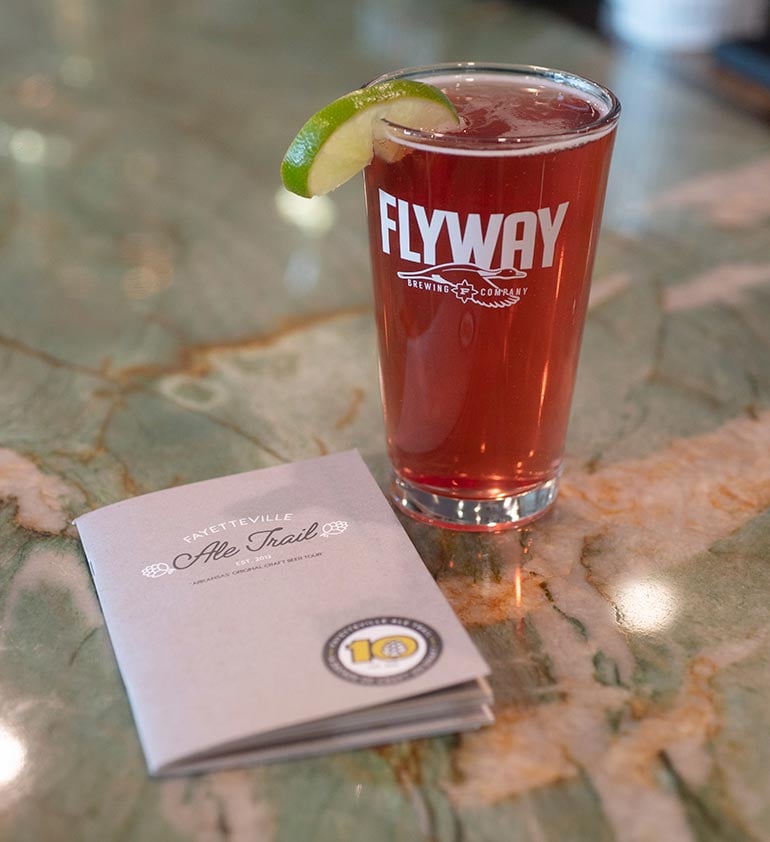
The Fayetteville Ale Trail is named for its hometown but represents the region as a whole. It was launched in 2013 by Experience Fayetteville, the city’s convention and visitors bureau. Visitors can obtain a printed passport that points them to area breweries. The passport is stamped at each stop and can be used to earn free merchandise bearing the Fayetteville Ale Trail logo when complete.
The name is an obvious misnomer since the passport program includes breweries in other cities, too. Bentonville, Fayetteville, Rogers and Springdale are the major municipalities of Northwest Arkansas. Each has a thriving beer scene and is represented on the Fayetteville Ale Trail. There are even a few outlying communities that have joined the program in recent years.
Nearly 150,000 passports have been distributed since the Fayetteville Ale Trail launched ten years ago. Sarah King works for Experience Fayetteville and is responsible for the program. She is proud of the ale trail’s growth. “Our mission is economic development through tourism,” she said. “The Fayetteville Ale Trail draws people from all over the country to experience our beer culture. Visitors contribute to the local economy and help our breweries find success. I think it has more than served its purpose in its decade of existence.”
The number of breweries on the Fayetteville Ale Trail has grown by 300% over the past decade. Today, there are 24 participants spread throughout Benton, Carroll and Washington Counties. Only a handful of breweries have yet to join the program, but King said recruitment efforts continue, and she anticipates full participation in the near future.
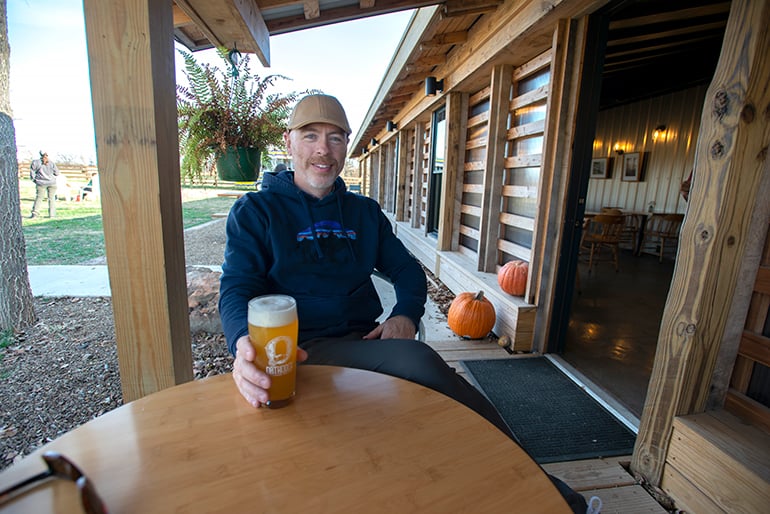
Brian Sorensen tries an offering from Orthodox Farmhouse Brewery in Fayetteville.
Northwest Arkansas has changed significantly over the past quarter-century. People who haven’t visited in a while would hardly recognize the place. While Fayetteville has long benefitted from the presence of the University of Arkansas, the communities to the north have been small and somewhat sleepy for most of their histories. The explosive growth of Walmart changed everything. Now firmly seated atop the Fortune 500, Walmart has turned its hometown of Bentonville into the epicenter of retail commerce. Decades of vendor relocations created a surge in population and a proliferation of new amenities.
Local beer wasn’t one of those amenities until recently. Benton County voted itself wet in 2012, paving the way for its participation in the craft brewing boom. “Many of the breweries in the program are outside our city limits now,” said King. “But we still call it The Fayetteville Ale Trail because our community remains the epicenter of craft beer culture in Northwest Arkansas.”
With nearly 100,000 people, Fayetteville is the biggest city in Northwest Arkansas. Today it is home to nine breweries, significantly outpacing Bentonville (three breweries), Rogers (four), and Springdale (three, if you count the local cidery). Fayetteville wasn’t always awash in craft beer. Prior to 1994, the only beer to be found other than mainstream lagers were Guinness Stout, St. Pauli Girl or a handful of beers shipped from overseas in green bottles. “Microbreweries” were novelties found somewhere else.
That changed when Ozark Brewing Co. (not to be confused with today’s Ozark Beer Co. in Rogers) started brewing beer in a remodeled historic structure at the intersection of Dickson Street and West Avenue. Fayetteville was already nurturing a small but dedicated community of homebrewers. Ozark’s arrival in 1994 lit the long fuse to the coming craft beer reformation with brewpub-standard stouts, IPAs, and hefeweizens.
Ozark proved popular with locals, but other beermakers were slow to follow. The next brewery in town, West Mountain Brewing Co., didn’t open until 2011. Tanglewood Branch Brewing Co. and Fossil Cove Brewing Co. followed in 2012. Apple Blossom Brewing Co. opened the next year, increasing the number of breweries in Fayetteville to five. Momentum was building and city leaders took notice. The Fayetteville Ale Trail debuted in 2013, putting a spotlight on local breweries and their cultural and economic impact.
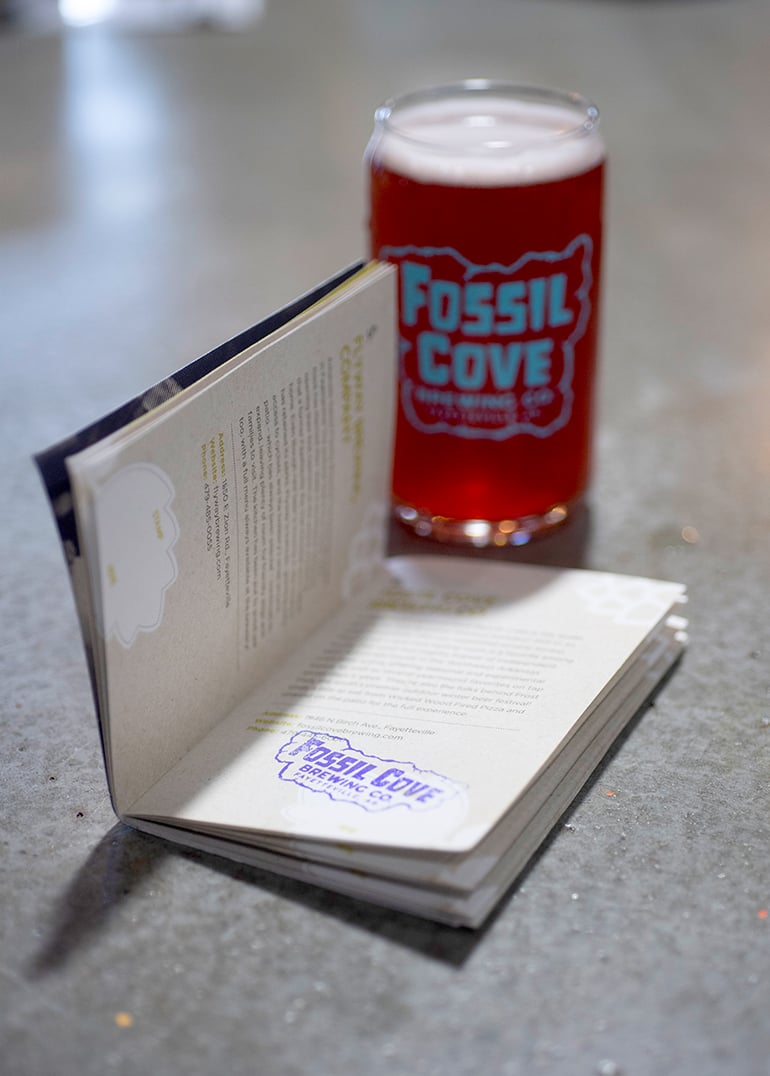
Fossil Cove stamp in an ale trail passport book.
Ben Mills is the founder, owner and brewmaster at Fossil Cove. His brewery was the first to join the Fayetteville Ale Trail, giving him a front row seat to Northwest Arkansas’s growing interest in beer. He sees the program as instrumental to the success of the region’s breweries.
“It’s hard to quantify the impact of the Fayetteville Ale Trail, but there’s no doubt it has been a big success for everyone involved,” said Mills. “Since the first printing, we can hardly keep the passports in stock in our taproom. We are constantly asking Experience Fayetteville for more copies.”
Mills still works behind the bar on occasion, and he meets people from around the country who are in town to fill their passports. But, just as importantly, the Fayetteville Ale Trail shines a light on area breweries for nearby residents, too. “There are a lot of locals who pick up their passports who don’t realize how many breweries there are in Northwest Arkansas,” he said. “It opens their eyes to what’s going on in the beer industry, which helps all the participants in the program grow.”
There is more to Northwest Arkansas than beer, of course. With an approximate population of 575,000, there is plenty of demand for other goods, services and experiences. One of the most notable amenities is the vast network of bike trails that weave throughout the region. Mountain biking, road cycling and e-bikes have exploded in popularity over the past decade.
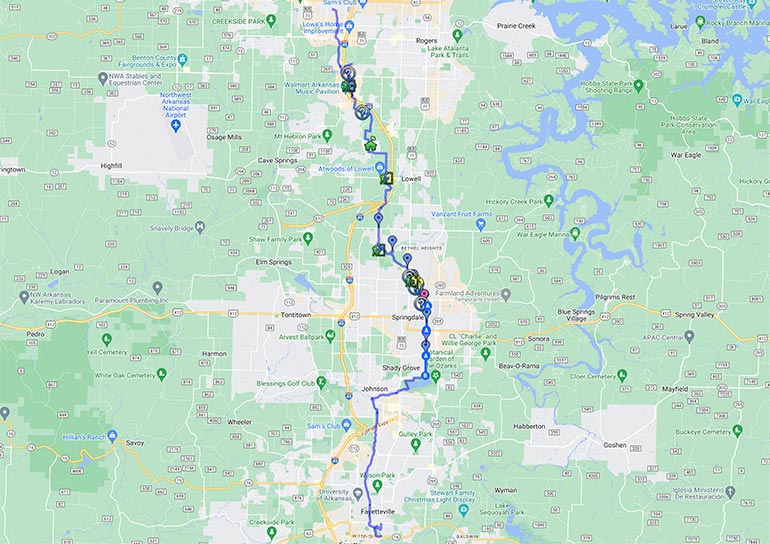
The Razorback Greenway is a 40-mile, multi-use paved trail that connects seven communities in Northwest Arkansas via bike trails and pedestrian walkways, providing easy access to local businesses as well as art and cultural centers.
“As the cycling culture has grown in Northwest Arkansas, many of the local breweries have served as a place for those communities to come together,” said King. The Razorback Greenway – a multi-use paved trail that extends 40+ miles from Fayetteville and through the other major cities – is the backbone of the area’s cycling infrastructure. Most breweries on the Fayetteville Ale Trail are accessible from the Greenway or one of its many spurs.
Dante Swanigan is a public relations intern at Experience Fayetteville. He hails from Marvell, Arkansas, a small town on the eastern side of the state. Seeing the synergies between the Fayetteville Ale Trail and the Razorback Greenway was eye-opening for the University of Arkansas student.
“I never would have thought to put biking and drinking beer together,” he said. “It seems like people would fall off their bikes after a couple of drinks! But it seems to be enjoyable for a lot of people. And they aren’t just doing it for the beer. It’s the company of friends and the journey itself for people who are experiencing the Fayetteville Ale Trail on a bike.”
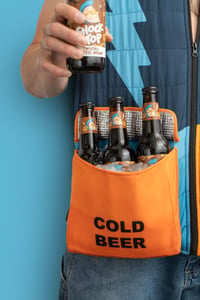
Whether by bike, on foot or via ridesharing services, it’s almost impossible to see the entire Fayetteville Ale Trail in one trip. 24 stops in three counties is a tall order, even for the most highly motivated visitor. Now people with less time on their hands can also earn a prize. “We created an intermediate award based on what we call the ‘Fayetteville Flight’,” said King. “If you go to all nine breweries in Fayetteville and get your passport stamped at each stop, you get a logo koozie with a strap, which can come in handy on a hike or on a river.”
The surge in brewing activity in the state’s northwest corner is a culmination of many factors. Population growth, a booming economy and a growing appreciation for locally made products have all played a role. However, success isn’t guaranteed. Left to their own devices, many breweries might get lost in the crowd and fail to live up to their potential.
“A lot of our breweries are small and don’t have big marketing budgets,” said King. “They might not be discovered without a little help. That’s the role the Fayetteville Ale Trail plays for participating breweries. We serve as a road map to their taprooms and help them grow their businesses.”
Some of the newest members of the Fayetteville Ale Trail include Fayetteville Beer Works, Mad Rooster Beer Co. and Orthodox Farmhouse Brewery – all in or near Fayetteville. While there are signals of distress in the nationwide brewing industry, the people behind these new ventures are confident that success can still be found in Northwest Arkansas.
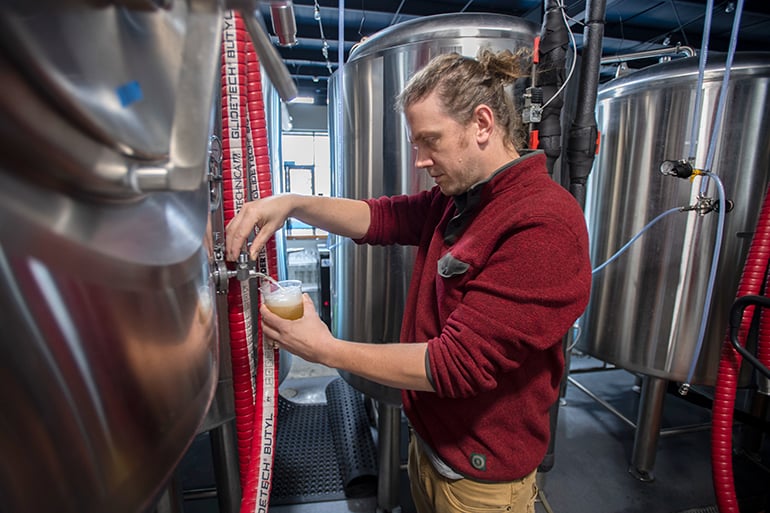
Brewer Peter Etges takes a sample out of a fermentor at Fayetteville Beer Works.
Fayetteville Beer Works (2649 E. Mission Blvd #1, Fayetteville) is unique in the way it approaches beer-making. Co-owner Brian O’Connell, formerly of Renegade Brewing Co. in Denver, and brewmaster Peter Etges handle hot-side wort production across town at Fossil Cove Brewing Co. The wort is then shipped in bulk containers to Fayetteville Beer Works and fermented there. Finished beer is dispensed through European-style faucets directly connected to serving tanks behind the bar.
O’Connell was quick to join the Fayetteville Ale Trail after opening Fayetteville Beer Works, noting how easy organizers made it for breweries to participate. “We were part of a similar program back in Denver,” he said. “But we were required to pay to be included and had to offer a discount on our beer. I asked how much it costs for a brewery to be a part of the Fayetteville Ale Trail and was told our fees would be covered. That was both unexpected and amazing to hear!”
Being a veteran of the beer industry, O’Connell is conscious of potential challenges his new brewery faces. Prices for ingredients, supplies and labor are increasing at a rapid pace, and growing competition makes success a goal, not a guarantee. Still, he sees Northwest Arkansas – and east Fayetteville in particular – as fertile ground for beermakers.
“The east side of town was lacking in hospitality options, overall,” said O’Connell. “I thought we could cater to east Fayetteville and make our taproom a gathering place for the community and not just a beer destination.” Craft breweries are generally thought to be welcoming places. They aren’t as rowdy as the typical bar, so people often feel comfortable bringing their children along with them. “That’s what we are aiming for with Fayetteville Beer Works,” said O’Connell. “Everyone is welcome here.”
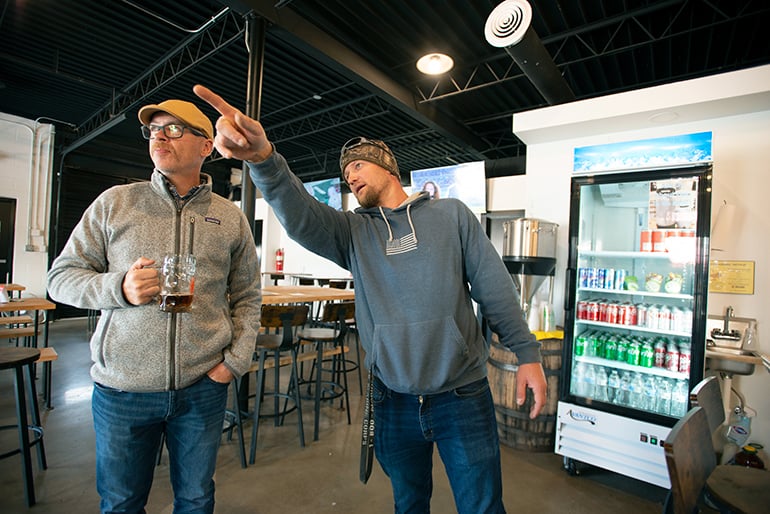
Brian Sorensen visits with Eric-Hahn, owner, at Mad Rooster Beer Co. in Fayetteville.
Mad Rooster Beer Co. (1107 S. West Ave, Fayetteville) is, for the moment, the southernmost stop on the Fayetteville Ale Trail. The brewery opened in a former machine shop, which maintains its muscular form following an impressive remodel. Brothers Eric and Jeremy Hahn and partners Brian Miller, Rob Sheverbush and Eric Wolfe are the owners.
Jeremy Hahn is the brewmaster and he brings plenty of experience to the job, having spent the past few years making beer at Excalibur Brewing Co. in Spring, Texas. He continues to brew at both places, traveling back and forth to keep fermentors full.
Eric Hahn said before the brewery opened, he enjoyed using the Razorback Greenway to visit breweries by bike. He sees benefits to being located close to the multi-use trail. “We aren’t directly on the trail here at Mad Rooster, but we are only a quarter-mile away. It definitely brings people in the door.”
For now, Mad Rooster is focused on building taproom sales and creating a loyal clientele. The brewery is in a growing part of Fayetteville that has seen a significant increase in population density in recent years. Students from the University of Arkansas live close by, as do families and older adults in established neighborhoods that surround the brewery. Food trucks and an abundance of big screen TVs make the taproom a comfortable place for Mad Rooster’s neighbors to hang out.
Mad Rooster plans to send beer to outside accounts at some point soon. However, the owners want to be methodical with their approach so they avoid the potential pitfalls. “We are ready to get distribution going,” said Hahn. “But we want to make sure we are ready for the demand before we do it. You only get one chance to get it right.”
Orthodox Farmhouse Brewery (15660 Ball Rd, Goshen) is a bit off the beaten path. Located 20 minutes east of Fayetteville in a rural community, it isn’t an easy commute. Still, scores of visitors find refuge from the hectic pace of city life in its taproom, on its porch or on the lawn that stretches across the peaceful countryside. Business has been steady since Orthodox opened in April 2023.
Orthodox is technically located in the Goshen planning district but has an Elkins address. Owners Ashlyn and Jesse Gagon live and work on the property, and they consider themselves to be a “Washington County brewery” to stave off the confusion. Jesse Gagnon previously brewed for West Mountain and Ozark Beer, both members of the Fayetteville Ale Trail. Putting Orthodox in the passport was a no-brainer for him.
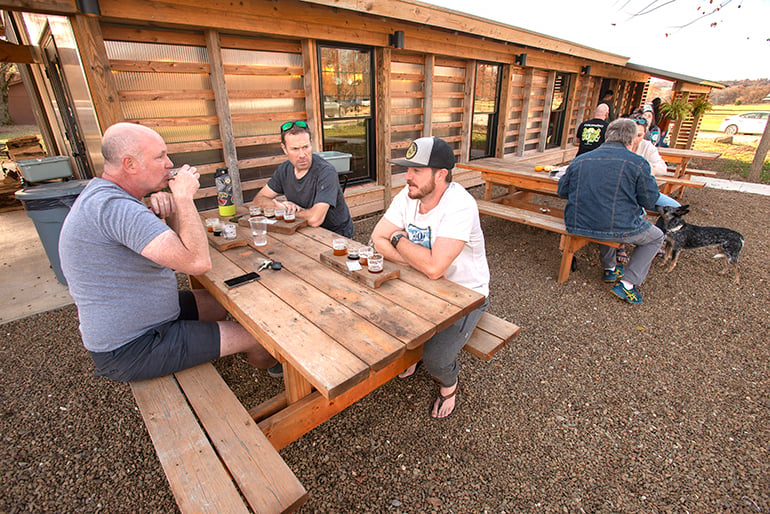
Guests enjoy mild weather while seated outside at Orthodox Farmhouse Brewery in Fayetteville.
“We didn’t have to debate joining the Fayetteville Ale Trail,” he said. “I feel like it’s an idea based on making breweries destinations, and we are a brewery that requires people to see us as a destination — unless you live right here on our road, which not many people do.”
The renovated barn that houses the brewery and taproom was meticulously rebuilt by Gagnon and a crew of friends and neighbors. The seven-barrel brewhouse produces Belgian-inspired beers that are elegant in their simplicity. Thus far, a Belgian white ale seems to be the strongest contender for Orthodox’s flagship beer.
The vibe at Orthodox is reminiscent of simpler times. The Gagnons want to highlight the importance of the agrarian way of life with their efforts. Hard work and caring about the land and its history are principles they hold dear. They both hope to see their little brewery become a place for the people of Goshen to come gather and celebrate their collective past.
“Things are changing in Northwest Arkansas very quickly,” said Jesse Gagnon. “We don’t ever want to lose sight of the things that got us to where we are today. That’s why we poured so much of ourselves into this place.”
Breweries in Northwest Arkansas are diverse in how they approach their craft. Some are big and some are small. A few stick to classic styles, while others push the boundaries of traditional brewing techniques. Regardless of your preferences, you’ll probably find something you like on the Fayetteville Ale Trail. Here is a brief introduction to the other breweries in the passport:
Fayetteville
Boston Mountain Brewing & Supply (121 W. Township St, Fayetteville) is a home brewer’s dream. A local supply shop moved into the taproom in January 2023, and now customers can grab a pint of beer brewed on site while they shop for ingredients. The brewhouse can be seen through a window behind the bar.
If you’re the athletic type, Columbus House Brewery (701 W. North St, Fayetteville) might be for you. Located adjacent to the Razorback Greenway, the brewery is a frequent staging spot for group runs and rides. Columbus House has been in business since 2015, with Spottie Ottie Oatmeal Stout being a favorite since the beginning.
Crisis Brewing Co. (210 S. Nelson Hackett Blvd, Fayetteville) sits adjacent to a longtime BBQ restaurant, just below the city’s downtown square. A small brewhouse supplies the diminutive taproom, with additional volume coming from a production facility located in a nearby industrial park. A comfortable outdoor area features open-air seating for pleasant weather, and an enclosed patio provides shelter from wet or chilly weather.
Flyway Brewing Co. (1550 E. Zion Rd #1, Fayetteville) is an outpost of the North Little Rock brewery of the same name. The Fayetteville location is located next to Veteran’s Park and is on a bustling spur of the Razorback Greenway. Flyway will make many of its mainstay beers there – including Bluewing Blueberry Wheat – as well as recipes that are unique to the site. A full-service restaurant sets it apart from most other breweries in the area.
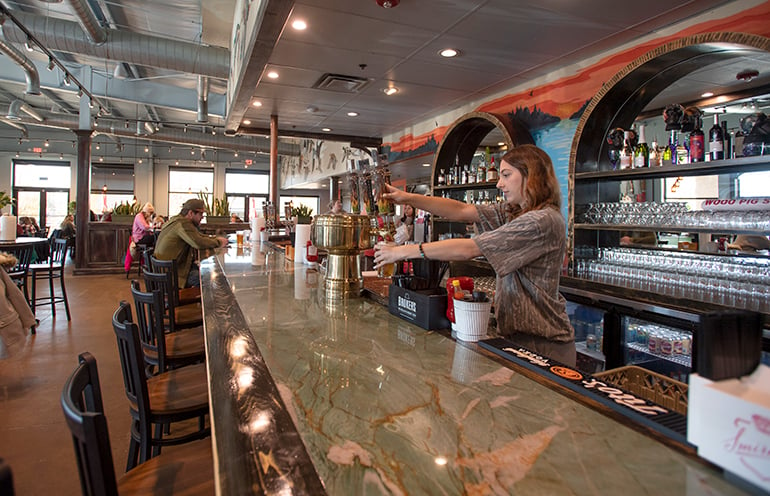
Bartender Ally Stogsdill pours a beer at Flyway Brewing Co. in Fayetteville.
One of the elder statesmen of the Northwest Arkansas beer scene is Fossil Cove Brewing Co. (1946 N. Birch Ave, Fayetteville). A large tap list, energetic taproom and youthful disposition make it popular with locals. Fossil Cove hosts the much-ballyhooed winter beer festival known as Frost Fest each February. One of its most popular beers is T-Rex on Peaches, a Belgian-style tripel aged in barrels and featuring lots of stone fruit character.
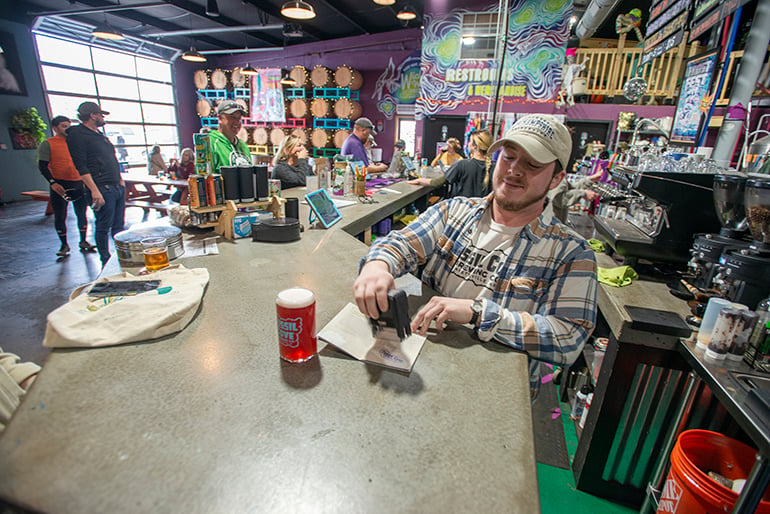
Bartender Ryse Caratini stamps an Ale Trail passport after serving a Blackberry Cream Ale at Fossil Cove Brewing Co. in Fayetteville.
Puritan Coffee & Beer (205 W. Dickson St, Fayetteville) slings uppers (coffee) and downers (beer) on Dickson Street, which is the heart of the city’s entertainment district. Yet somehow the place maintains a studious vibe thanks to the undergrads who congregate there during the day. A miniscule brewing system yields only three beers – Pale 8, Pale 13, and Dark 13 – but Puritan also features a nicely-curated list of guest taps.
West Mountain Brewing Co. (21 W. Mountain St, Fayetteville) is the oldest active brewery in Fayetteville. The seven-barrel system in the street side window sat dormant and teased passersby for a decade before Andy Coates – now co-owner and brewmaster for Ozark Beer Co. – fired it up for the first time. Coming Soon Pale Ale was the first beer off the taps, a tongue-in-cheek nod to the extended wait. The cracker crust pizza has been a local favorite for decades.
Bentonville
Bentonville Brewing Co. (901 SW 14th St, Bentonville) is one of the biggest breweries in the state. In 2022, Bentonville brewed 5,460 barrels of beer, good for third-most among Arkansas beer makers. It operates out of an expansive brewery and taproom, which features a large outdoor seating area that is kid- and dog-friendly.
The first brewery in Bentonville was Bike Rack Brewing Co. (801 SE 8th St #61, Bentonville). It was located in a different place when it opened in 2014. Today it co-exists in a multi-use complex with the Brightwater Institute of Culinary Sciences and a number of eateries and other merchants. You can make it a true sensory experience if you plan carefully.
Social Project Brewing Co. (600 SW 41st St #4, Bentonville) actually has two locations. The place where the beer is made is located in Bentonville. A satellite taproom is located just off Emma Avenue in downtown Springdale, giving folks in Washington County a place to go to get their fix. Social Project is big on hazy IPAs, sours and stouts.
Rogers
Natural State Brewing Co. (5214 Village Pkwy #140, Rogers) is located in the Pinnacle Hills area of town and focuses on traditional German brewing techniques. The brewery adheres to the “Reinheitsgebot,” the 16th-century German purity law that requires beer to be made exclusively from water, barley, hops and yeast. From time to time you’ll find something more adventurous on tap, such as a bourbon barrel-aged schwarzbier.
New Province Brewing Co. (1310 W. Hudson Rd, Rogers) is a growing brewery that recently changed ownership. John Lee leads a group of investors who acquired the maker of Philosopher King IPA and Fallen Queen Belgian Witbier. More adventurous beers continuously roll off the canning line and can be found at package stores throughout Northwest Arkansas.
One of the better-known breweries on the Fayetteville Ale Trail is Ozark Beer Co. (109 N. Arkansas St, Rogers), which launched in Rogers in 2013. The venerable beermaker is most well-known for its Bourbon Double Cream Stout, but it was Paper Game – its American/Belgian farmhouse ale – that won a 2023 bronze medal at the Great American Beer Festival.
Rendezvous Junction Brewing Co. (2225 S. Bellview Rd #101, Rogers) is one of the feel-good stories on the Fayetteville Ale Trail. Co-founder Mike Peerson left a lucrative job in the corporate world to open the brewery with his son-in-law. He later suffered a serious injury while riding an all-terrain vehicle and was airlifted to a nearby hospital. He miraculously recovered, and Rendezvous Junction grew into the brewery he dreamed it could become.
Springdale
Black Apple Hard Cider (321 E. Emma Ave, Springdale) taps into the region’s history of apple production to provide a lone non-beer option to the Fayetteville Ale Trail. Located on newly hip Emma Avenue in the city’s downtown district, Black Apple produces a wide variety of ciders. Most are surprisingly dry compared to the national cider brands.
Technically, Core of Arkansas (2470 Lowell Rd, Springdale) started brewing beer in 2010, although founder Jesse Core didn’t move production to its current location until 2012. In recent years Core has shifted its focus to hard seltzer. On the strength of Scarlet Letter Spiked Seltzer, the brewery has grown into the second largest in the state, producing an impressive 8,435 barrels in 2022.
Saddlebock Brewery (18244 Habberton Rd, Springdale) opened in 2012 and is near the confluence of Beaver Lake and the White River. A serene landscape surrounds the brewery, which recently saw a significant remodel of its taproom.
More on the Trail
Eureka Springs Brewery (96 Ridgeway Rd, Eureka Springs) is located about one hour northeast of Fayetteville in a mountain town often referred to as the “Little Switzerland of the Ozarks.” Eureka Springs has a strong non-conformist vibe and is full of artists, musicians and writers. The brewery takes a more conventional route with its beers, with a tap list full of wheat ales, pale ales, red ales and stouts.
GOAT Lab Brewery (722 S. Bloomington St, Lowell) shares ownership with The Grove Entertainment Complex – a nearby comedy club – and focuses on German styles of beer. Grab a pint of hefeweizen in the taproom and see if you can spot a famous comic settling his nerves before a show.
Ivory Bill Brewing Co. (516 E. Main St #1, Siloam Springs) is located in a charming downtown area that has seen a resurgence in recent years. Co-owner and brewmaster Casey Letllier brews a wide range of beers on the wood-clad British brewing system. Ivory Bill is the western-most brewery on the Fayetteville Ale Trail, with the Arkansas-Oklahoma state line a short distance away.
The Recreation Parlor (104 2nd Ave SE, Gravette) opened in 2021 and is owned by Nebraska natives Travis & Sylvia Norris. The brewery occupies a 19th-century building that features a bar used in the Marshall Fields store in Chicago around that same time. The Recreation Parlor is the only brewery and/or bar in Gravette.
Photograpy by: JT Wampler


Conversations (0)
No comments yet.