


Here’s to Beer: New Questions About Drinking and Health
As new health reports question alcohol’s impact, craft beer lovers are reexamining their drinking habits. Is moderate consumption still beneficial, or is it time to rethink our relationship with beer?
 Story by:
Jonathan Ingram
Story by:
Jonathan Ingram
I vaguely recall when “dry January” was a reminder to pay more attention to skin care products due to the low humidity in the winter months. The phrase is now among a litany of invitations to reconsider my love of craft beer.
The Surgeon General recently called out all forms of alcohol use as the third-leading cause of cancer, in January no less. Perhaps it’s time to revisit my affair that began with the arrival of Anchor Steam in national distribution along with Pete’s Wicked Ale and Sierra Nevada Pale Ale. No matter where you traveled or lived—in my case Georgia—by the early 1990s craft beer was at hand.
How far we have come from the day President Jimmy Carter, a notable do-gooder and teetotaler, signed a bill legalizing homebrewing, which in turn led to a boom in craft brewing. An entire movement erupted when independent brewing was embraced and led by millennials, who believed in the positive influence of craft breweries on their communities. The beer itself was often viewed as an elixir, if not a restorative.
Sigmund Freud, an expert on sorting out well-being, observed that intoxication is one of life’s great pleasures. These days, I’m hearing that my favorite form of intoxication could be toxic. And that some Gen Zs are turning up their collective nose at craft beer.
My disbelief about the contrary news when it comes to drinking a fresh draft has forced the question. Are two beers a day good for me in numerous ways, including my physical health?
There’s cosmic satisfaction in raising a beer to yet another turn of the Earth. The older I get, the more valuable this ritual becomes. It marks time’s passage in both worldly and mystical ways, like the nomad of no origin or destination who trudges daily through the sands under the piers on Cannery Row.
The Surgeon General’s report hit like a loud, unwelcome noise in an adjacent room. What was that? At first blush, the report reminded me of the announcement in 1964 that smoking tobacco caused cancer.
It was a no-brainer that the smoke from cigarettes would leave your lungs yucky and quite possibly lead to bad outcomes. I remember well those who stacked up their cigarette packs and threw them away once the announcement came across on the evening news. Since then, a series of political decisions based on the Surgeon General’s report have led to a significant decrease in smoking, lung cancer and heart disease, all good outcomes.
Going further back on the time machine, the 1950s were awash in post-War alcohol consumption. I witnessed it as a wee lad at the parties in my neighborhood. But the rates of alcoholism in the U.S. leveled off 45 years ago. Over time, there has been a shift to what became a widely accepted cultural message. Moderate use of alcohol can be healthy, the three-martini lunch not so much.
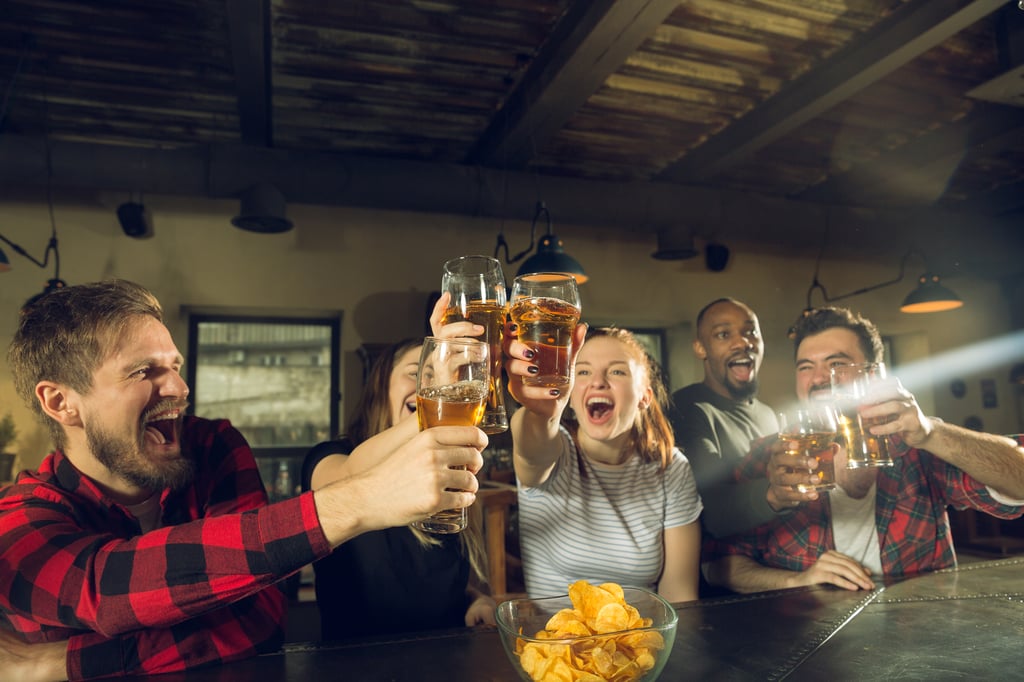
My father, a hard-drinking attorney who preferred Manhattans and martinis, was the first to counsel me to learn how to drink only two beers. Finding beer more to my liking than spirits or wine, I finally took up that sound advice in my early 40s, because drunkenness is not conducive to worthwhile conversation, much less driving, and I didn’t like hangovers.
Given the misinformation constantly coming through the transom of electronic media like some slime creature out of Dr. Venkman’s worst nightmare, we are constantly pushed toward choosing a belief system rather than keeping up with the political shuttlecock that used to be known as the facts.
Previously, we could rely on age-old and respected tenets when it came to telling the world to get lost, such as “Get off my lawn!” Or, perhaps the more modern derivative. “Curb your dog—and have those oversized genitalia clipped.” These days we are sometimes reduced to shouting at the nearest electronic screen or believing that our social media comments might re-establish a more welcome reality.
When it comes to the current findings on drinking within the scientific community, there are significant disagreements that are noteworthy. The National Academies of Science, Engineering and Medicine does not find a significant correlation between two drinks a day and cancer. The lone exception is a “low certainty” of an increase in female breast cancer beyond one drink per day.
An independent non-profit, the Academies’ findings support a correlation to longer life and better resistance to cardiovascular disease for moderate drinkers. Its report, released in December, resulted from an inquiry made by the U.S. Department of Agriculture in conjunction with a Congressional committee examining dietary guidelines for upcoming labels on alcohol products.
The ultimate question concerns my life being cut shorter or being interrupted by cancer because of my lifestyle. Having done my own forensic research to reach my current age, the answer is yes, I’ll have a beer.
Few endeavors alleviate stress or give me a better sense of just letting go of life’s hassles—such as the aforementioned electronic transom—like a beer. An interruption on behalf of looking over my shoulder at a past that might be gaining on me in the form of cellular destruction, methinks, would not be cured by a month here or a month there of abstaining from alcohol. Or not drinking at all. To me, moderation, which has little discernible influence on my physical health, is the epitome of personal discipline.
My enjoyment of craft beer has one well-known appeal beyond the salubrious effects of alcohol. Nothing is quite like a hoppy beer high. To reframe the words of poet Edna St. Vincent Millay, drinking an IPA, whether a hazy or not, can cast such “a lovely light.”
After bending an elbow in many a tasting room, I’ve concluded that freshly brewed hops promote good health in a way that feels like an analgesic for the brain. It’s not just me. A study published by the National Institute of Health in 2021 found that hops in beer “significantly improved total mood state, including anxiety, depression, fatigue, and vigor.”
Hops can temporarily add energy as well? Magical. No wonder conversations rise and fall by leaps and bounds in tap rooms at breweries specializing in IPAs.
Alas, if you drink two IPAs, the intake is likely to exceed a moderate level of alcohol. But thanks to the independent brewing industry, choosing a low-alcohol lager followed by an IPA has its rewards these days in both flavor and beyond.

Comments 0
No Readers' Pick yet.