



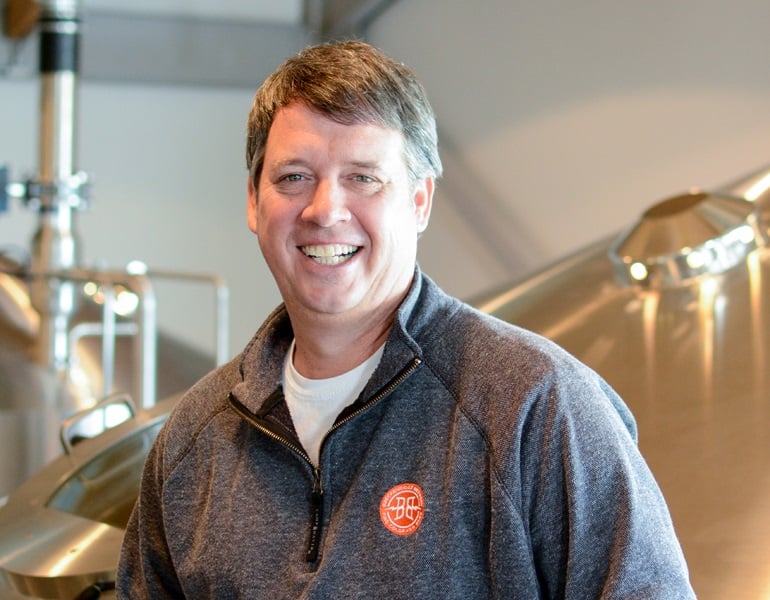
Todd Usry of Breckenridge Brewery
 Story by:
Jonathan Ingram
Story by:
Jonathan Ingram
Todd Usry is one of the new faces of craft beer, even though he’s been working at Breckenridge Brewery since 1990 when he started as a delivery truck driver for what was then a 3,000-barrel brewpub in one of Colorado’s ski towns.
As the recently named president at Breckenridge, Usry is committed to maintaining the quality and innovation that helped the brewery become one of the top brands in its beer-crazy home state and on the national scene. And, oh yes, he’ll be working in The High End division of Anheuser-Busch InBev.
It’s the recent acquisition by the world’s largest brewery that has reshaped Usry’s role in the brewing world. He’s still committed to flavorful and authentic beer, but many people who support craft beer think ownership by a mega brewer is anathema to the mission. There is the fear that mega brewers will try to muscle out independent regional operations as they did midway into the 20th Century, when America was turned into a light lager desert.
That lagering of the beer universe ultimately created the craft beer counter-revolution led by independent brewers who fought for two decades to gain a foothold against the big brewers. Working his way up to brewmaster and then brewery director at the new $36-million Breckenridge farmhouse-style brewery in Littleton, Colorado by “hard work, initiative and luck,” Usry was a front line soldier in the revolution.
Then came the offer from AB-InBev and The High End division, which already operated formerly independent brands such as Elysian in Washington, 10-Barrel in Oregon and Goose Island in Chicago. In a classic case of how the craft mission suddenly gets turned upside down, Usry was outvoted by partners who wanted to sell.
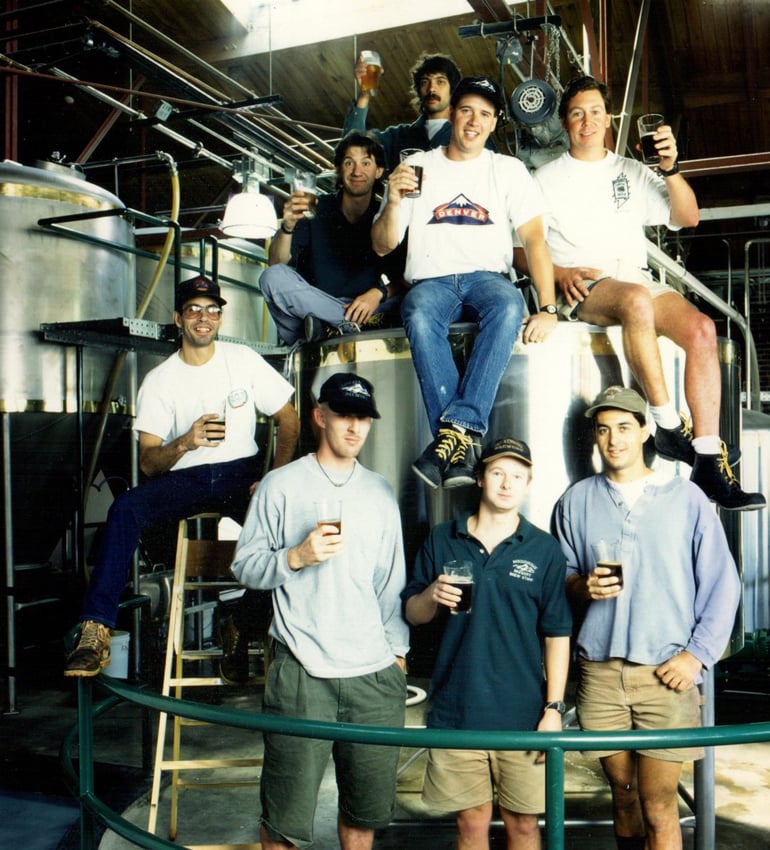
The Breckenridge crew circa 1993. Usry (in center, seated) started working for the brewery in 1990 as a delivery truck driver.
Having combined two Denver-based brewpub operations in 2010 to create Breckenridge-Wynkoop LLC, owners Ed Cerkovnik and Lee Driscoll decided to sell their interest in the production brewing business to concentrate on the restaurants.
Other shareholders were involved, but essentially Usry was outvoted. Having just spent the better part of two years building a new, state-of-the-art destination brewery on the banks of the Platte River south of Denver, Usry was angered by his partners’ decision to sell. Then the strongest offer came from The High End.
“I had mixed emotions for sure, especially when I learned we were sitting down with Anheuser Busch’s High End team,” said Usry. “I’ve been fiercely craft my entire career – a quarter of a century – you can imagine my first, initial thoughts. After meeting with those guys several times I absolutely became a believer in what they’re trying to do. What they’re trying to do is not take over the craft world. That’s not their ambition. They’re trying to participate in it. I think it’s a smart play on their part.”
The easy conclusion is that Usry, who became president as a result of a deal conservatively estimated to be worth $100 million, sold out. But he sees it as an opportunity to sustain the commitment to the employees at Breckenridge and to bring more flavorful beer to the marketplace.
“The most important thing to me is my people, as clichéd as that might sound,” he said. “I’m incredibly proud of the people here. I’ve got people who have been here 24 years and I’ve got several people who have been here over 15 years. We’re extremely close. We go through all the highs and lows of life together. I’m really proud of the beers we make, I’m really proud of the creative steps we’ve made with our beers over the last five to seven years with all the new entries and all the barrel-aging stuff we’ve done. I’m real proud of all of that, but what I’m most proud of is my co-workers and the team of people here. When The High End was here, I know they noticed that and they told me they noticed. That probably is the best compliment I can get.”
Being owned by a brewery, said Usry, is a better option than being owned by private equity or bankers. There was shock, he acknowledged, when he informed his employees of the acquisition and not much awe. There were the anticipated vindictive messages in social media. A sustained effort to communicate with the Colorado media – as throughout the brewery’s more than two decades of growth – resulted in some negative stories. But Usry stood his ground and rallied his employees. There were no immediate notices to quit or move elsewhere.
Usry said he’s not worried about losing the brewery’s independence and that he believes it can continue to be well-connected to the Colorado lifestyle that helped inspire Vanilla Porter, Avalanche Amber and, more recently, Ophelia Hoppy Wheat plus a nitro version of Vanilla Porter.
Andy Goeler, VP of Marketng for The High End, said the acquisition of Breckenridge was focused on innovation. “Breckenridge Brewery has a long history of innovation and they continue to brew new and exciting beers, from their specialty brews like the Mountain Series that celebrates the brewery’s origin as a ski town brewpub, to their planned nitro can series,” said Goeler. “They are innovative and have built an amazing business that’s enabled them to get their great beers to fans across the country. We look forward to even more growth together.”
Usry said he’s not worried about losing the brewery’s independence to AB-InBev and that he believes it can continue to be well-connected to the Colorado lifestyle that helped inspire Vanilla Porter, Avalanche Amber and Ophelia Hoppy Wheat.
“They want me to do what I do and to remain focused on growing Breckenridge Brewery within the culture we have created here throughout the years,” said Usry of the meetings with executives from The High End. One of those on hand to help with the acquisition was J.B. Shireman of the investment banking firm First Beverage Group. Shireman spent 13 years helping to grow New Belgium Brewing Company and is a friend of Usry.
“They’re into individual stories, which I think craft is built on completely,” said Usry. “That is all that you hear out of them. One of my first questions was autonomy. What’s going to happen to decision making? They said, ‘We don’t want to run your brewery. It’s all yours. We want you to run it as you have. We’re just looking to help you grow it and to give you all the resources necessary to do that and to maintain quality.’”
Usry vows the commitment to innovation and quality will determine the course of Breckenridge’s future, which continues to be aligned with the same themes of fun and connection to the Colorado lifestyle that have characterized a company that once brewed near Coors Field and made special beers for Comic Con such as Brews Wayne and Caped Brewsader. For years Leftover Salmon, a local group, has been the “house” bluegrass jam band.
One of the objectives of The High End is to purchase breweries that have brewpubs and tap rooms that are a destination in their own right. The new Farmhouse Restaurant that adjoins the brewery in Littleton and its access by car, bike or the river made Breckenridge very attractive once Cerkovnik and Driscoll, experts in restaurant development, decided to sell and focus on their seven other eateries in Denver and Colorado Springs that remain under the Breckenridge-Wynkoop banner.
“Our beer garden was in full swing, our restaurant was jammin’ (during transition talks),” said Usry. “When they were here everything was buzzin’ with life and they brought it up. They’re big on the experience. They’re improving beer gardens and pubs in some of the other locations.”
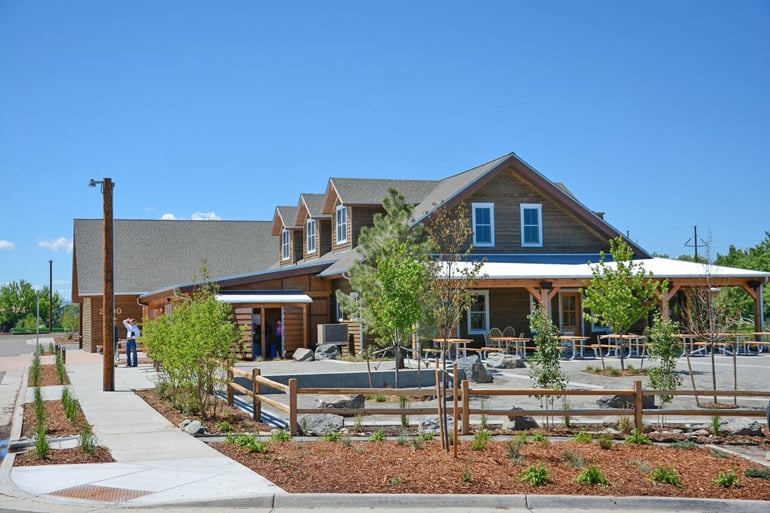
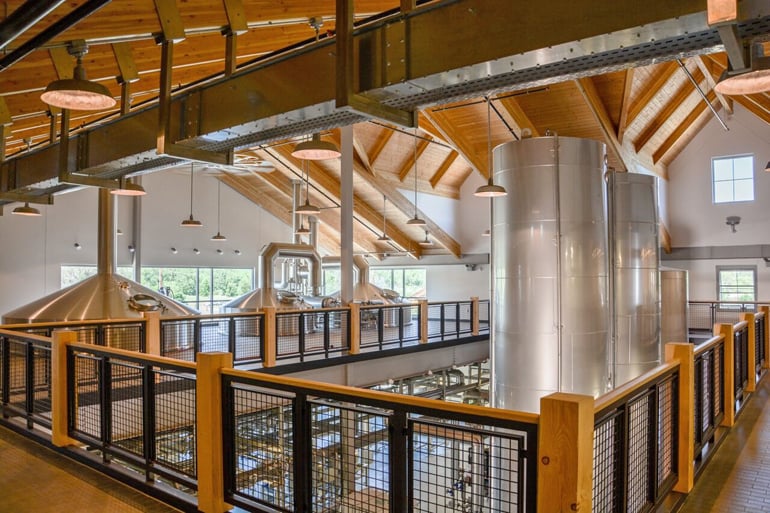
One of the objectives of AB-InBev’s High End line is to purchase breweries that have brewpubs and tap rooms that are a destination in their own right, such as Breckenridge’s new Farmhouse Restaurant in Littleton.
The brewery’s new Steinecker system, which car lover and NASCAR fan Usry likens to having a hot new performance vehicle, has helped the transition. The 400-barrel system is fully automated, allowing control by the brewing team from a computer screen. Having produced 70,000 barrels in 2015 following a move from the Denver brewery in May, the facility is capable of producing 120,000 barrels currently and can be outfitted to produce 300,000.
The use of recycled materials, LED and natural lighting, plus the German brewing system’s efficient use of water keeps the brewery in line with Colorado’s emphasis on green technology. The ability to produce beers in 100-barrel batches helps sustain creativity. Last year, the brewery introduced 13 new beers, including a whiskey barrel-aged version of 471 Double IPA and a tequila barrel-aged version of Ophelia Hoppy Wheat, which first arrived last spring as a new seasonal.
There’s no mistaking the Colorado theme to the brand, which distributes a Rocky Mountain Sampler, and Usry says the Breckenridge beers are made with balance as well as innovation to keep them approachable. (The company bucked trends to stay with lagers longer than most craft breweries and even had a 3.2 percent ABV “active lifestyle” beer sold only in Colorado, which has been discontinued.) It was fairly amazing that the company introduced so many new beers in the same year it transitioned from its previous brewery on Kalamath Street in Denver.
“We have a very dynamic R&D team comprised of pub and packaging brewers, quality control, and sales & marketing team members,” said Usry. “That diverse group of contributors brings recipe and style ideas from a lot of different angles. We use our (original) pub in Breckenridge as our ground zero R&D lab, and then we bring qualifying ideas to Littleton to share in our Mountain Series, Brewery Lane series, and Small Batch line.”
An alignment with The High End will boost creativity, said Usry, because collaboration with the division’s other brewing operations is now built into the process.
“I will sit on the craft advisory board with principals from all those breweries and I’m psyched about that,” he said. “I think that will be good for our brewery and challenging for me in the next phase of my career. I’m also looking forward to collaborating with Anheuser-Busch. Say what you will about Anheuser-Busch, there are decades and decades of research when it comes to quality and when it comes to everything from malt to carbonation. Never have I had these kinds of resources at my fingertips. Again, I’m very excited about that opportunity.”
It will be a challenge for the former delivery man who learned how to brew on the job. “What they expect of me is probably a lot. I’m sure it’s a lot. It’s not different from what I’ve been doing all these years. We’re going to grow. There’s going to be pains. We’re going to grow faster than we could have done without the help. I’m going to have to up my game to keep up with that. That’s going to be adding tanks, construction, adding warehouse space, working with new wholesalers, I’m sure, as we kind of align our footprint.”
It might have been easier to take the money and walk away, find a job at another independent brewery or join one of the new “craft conglomerates” designed to create more size in order to do battle with the macro brewers. Or, instead of driving a Ford Explorer to work every day, Usry might have found a snazzy new car or pick-up truck and headed to the Daytona 500 and other NASCAR events at his leisure. But that’s just not Usry’s style.
For one thing, he doesn’t believe The High End division will lead to the end of independent craft brewing. “The High End enjoys obvious distribution and logistical benefits that come from being a part of the world’s largest brewer,” he said. “This allows The High End to put craft beer in more consumer hands than ever before. New consumers experiencing craft beer – owned by The High End or otherwise – will continue to seek out craft beer in their local markets and beyond.”
Like most brewers, Usry likes the idea of creating, brewing and selling more beer. “It’s not like I get to kick back now and reap the benefits,” he said. “Our whole team is going to have to ratchet it up a bit, but not in terms of ‘walk between these lines.’ They don’t want us to do that. They want us to wiggle around the lines as we’ve been doing at Breckenridge.”
Comments 0
No Readers' Pick yet.