






Judge’s Review: 84 Rating – KEREL Kaishaku by Verbeeck-Back-De Cock Brewery
Verbeeck-Back-De Cock Brewery
 Story by:
Scott Birdwell
Story by:
Scott Birdwell
Belgian Golden Strong Ale | Year-Round | Belgium

By Scott Birdwell
Judges Rating: 84
Aroma: 18
Appearance: 5
Flavor: 34
Mouthfeel: 9
Overall Impression: 18
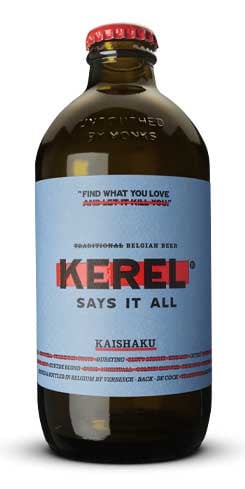
KEREL Kaishaku by Verbeeck-Back-De Cock Brewery is being evaluated as a Belgian Golden Strong Ale (BJCP Style #25C). The beer pours deep golden in my glass with good clarity. The head, while not thick, does linger. Initial impressions from its bouquet is one of over-the-top alcohol content. Not surprising, considering this one comes in at no less than 15% ABV! I do pick up hints of Belgian phenols up front, but overall I would say the aroma is somewhat subdued for a beer with this much kick and this many ingredients crammed into a 333ml bottle.
Upon tasting, I am almost overwhelmed with its initial intense sweetness. This intense sweetness carries through in the finish. Frankly, the sweetness is headed down the path to “cloying.” To make a beer of this strength, a massive charge of pale malt must be used. That would account for a fair amount of the sweetness, but not all. I can barely taste hardly any appreciable amount of hop bitterness or finish in the beer. And, while I wouldn’t expect a lot of hop bite for this style, with this much malt underneath, more hops are desperately needed to add some sense of sweet/bitter balance. It’s just not here! The flavor does show some of that funky phenolic twang of so many Belgian ales, but overall, it is relatively clean, without so much of the funk that you might expect from a strong Belgian ale. The brewery employs sake yeast in this beer. I am going to push the boat out and venture a guess that this is done to allow the fermentation to reach that 15% level. Perhaps they pitch their house strain initially to add the familiar Belgian twang, but then need to re-pitch with the sake strain to take the beer the rest of the way to 15%. Again, just a guess (but an educated one). Perhaps the sake yeast doesn’t contribute those Belgian phenols, resulting in that clean finish.
In terms of mouthfeel, the beer is obviously very full-bodied and the 15% is “warming,” to say the least! Carbonation is appropriate and the beer finishes with little or no astringency – very clean. After finishing my initial tasting, I was, on the whole, underwhelmed. However, as the sample warmed up, almost to room temperature, I discovered some of its charms became more apparent. I was mildly surprised because the sample wasn’t particularly cold when first tasted. This golden-hued ale bucks the accepted wisdom of “the paler the hue, the colder the serving temperature.”
I find this beer somewhat difficult to evaluate. It is obviously way too strong, too full-bodied, and way too sweet for a classic Belgian Golden Strong Ale. By those standards, this is way off-track. However, I don’t think that is what the aim was when the beer was brewed. Perhaps, this should be be regarded as an Experimental Beer… But, then the guidelines for that style are understandably vague! For my part, I choose not to penalize this beer for lack of adherence to the Belgian Golden Strong Ale guidelines, but rather on its own merits, or lack thereof. My main issue with this beer is the lack of balance in the malt/hops continuum. This beer is very, very sweet! It could really use some more hop bite just to tilt the scale a little more to the center. My other question is perhaps existential: why does it exist? You can find great Belgian Golden Strong Ales ranging from 7 – 10%, yet despite that strength, are deceptively quaffable. Do we need a 15% version? For me, not so much, but, you can judge for yourself. If you’re interested in discovering what a 15% Belgian Golden Strong Ale tastes like, give this a try.
Share options
Share This Article