








Tapping Into Infinity Through Ancient Drinking Games
 Story by:
Jim Dykstra
Story by:
Jim Dykstra
Remember your favorite drunken night? Your greatest feat of skill? What do they have in common? They felt impossible. Like you pierced through time with a golden needle, weaving magic with every word and action. You may have felt invincible, unbounded by time or place.
There’s a reason we love drinking games. They put us in a state of mind that seems to exist beyond the bounds of ordinary life. Closer to transcendence. Here we’ll look at two of the oldest known drinking games, and see what they tell us about the human experience.
Kottabos: The World’s Oldest Drinking Game
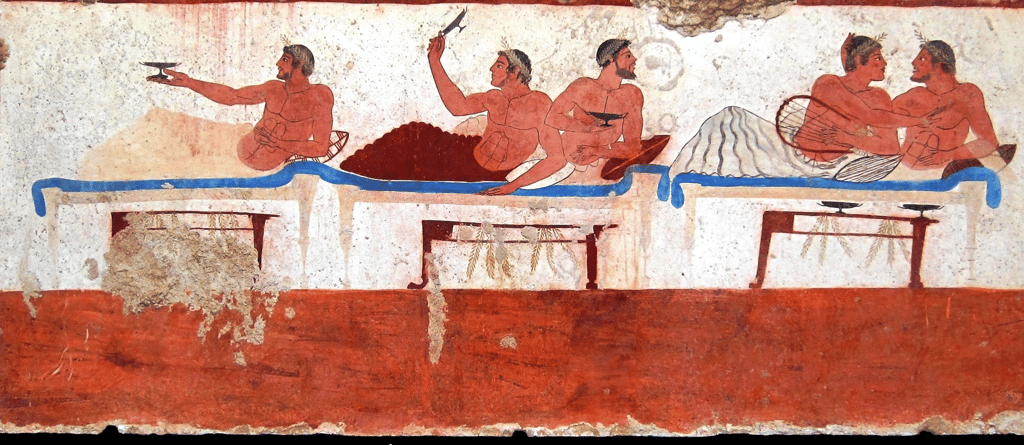
The oldest formalized drinking game we are aware of comes from 6th century BC Greece: Kottabos. Played at the symposium, which was like a post-dinner drinking party, men, and less commonly, women would lounge on couches around a target, leaning on their elbows, and take turns slinging leftover wine sediment at a target from their shallow “kylix” cup.
Greek playwright Antiphanes described kottabos this way:
“The kottabos player puts the index finger of the right-hand through the handle of the drinking cup, palm upwards; and the remaining fingers are spread as playing a flute. The player reclines on the couch, leaning on the left elbow; and, moving only the right-forearm, throws the wine-lees.”
The target was a small saucer called a plastinx, balanced on a pole, or floating on water. The goal might be to knock the saucer off the pole with the customary overhand toss, or to land it on the saucer with a satisfying “smack.”
This game was baked into Greek culture, enough that special buildings were made with a circular design, allowing for equidistant tosses from all players. These days, kottabos would probably boast an organized league and accompanying Youtube channel. A winner might expect to receive “cakes, sweetmeats, or kisses,” along with a hefty dose of social cachet. Possibly even a servant.
Beyond mere material stakes, love played a big part of kottabos. A dedication preceded every throw. One of the most famous examples found comes from an inscription on a vase from a heterai, or female courtesan-type figure named Smikra. “Tin tande latasso leagre,” she states. (I am throwing this for you, Leagros).” Leagros was somewhat of a Timothee Chalamet of his day.
Each throw symbolized an embodied question of love, and the uncertainty surrounding the success of a throw mirrored the uncertainty one feels before love is affirmed. Were the throw to be true, the special sound it made would be interpreted as a sign that “He loves me,” rather than “He loves me not.”
Finite and Infinite Games
There is an interesting little book about games, philosophy, or life itself, by James Carse, called “Finite and Infinite Games”. It’s full of aphorisms which readers find either self-indulgent or mind-altering.
“A finite game is played for the purpose of winning, an infinite game for the purpose of continuing the play.”
or
“To be serious is to press for a specified conclusion. To be playful is to allow for possibility whatever the cost to oneself.”
In games, there is a degree of uncertainty. Without it, a game becomes merely mechanical. Such is also true of life. The degree to which one’s life is uncertain is the degree to which one allows for chance, possibility, and new connection.
In Kottabos, there is both seriousness and play, in the name of winning the finite game (hitting the target), yet also continuing the play of what one might consider an infinite game (love).
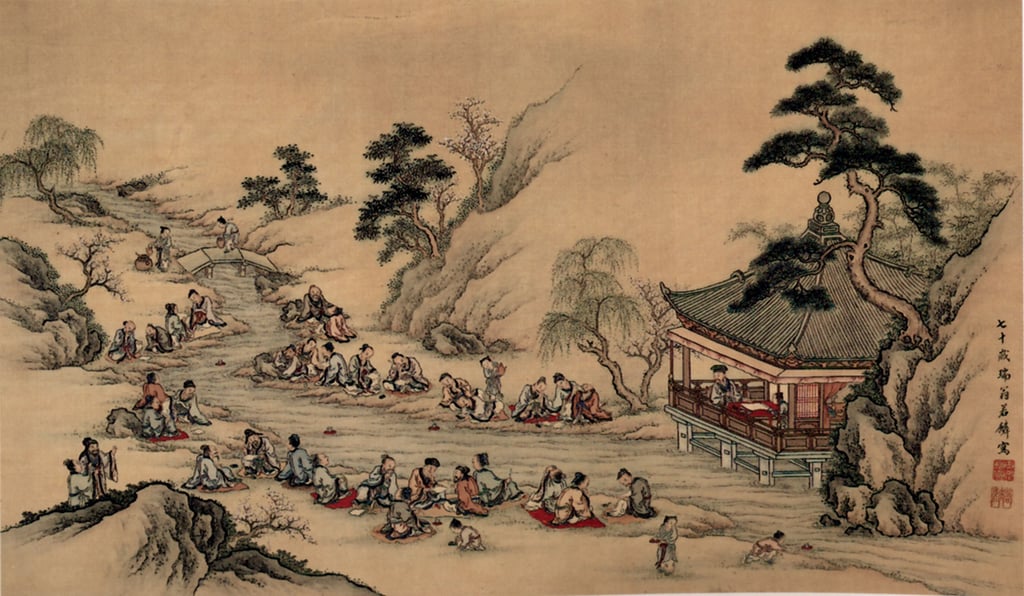
The Winding Stream Party
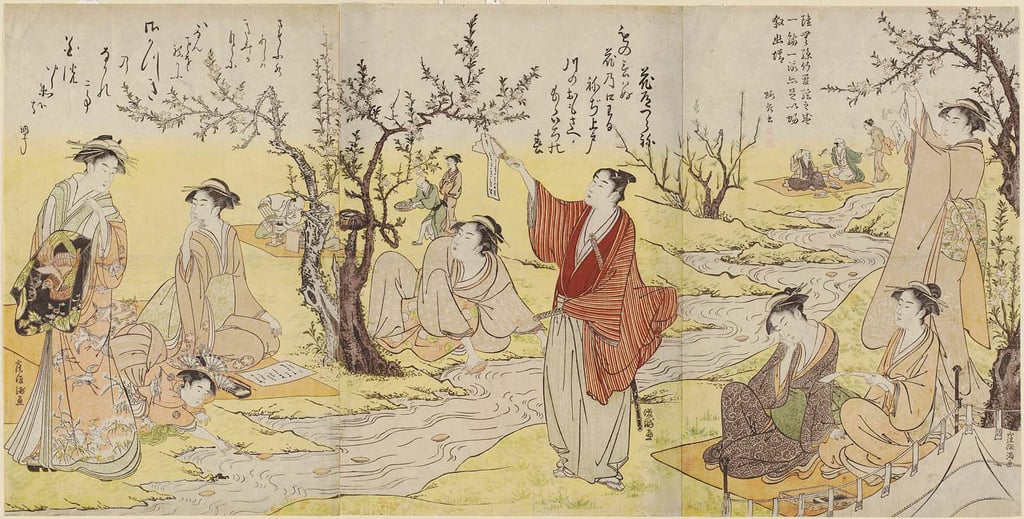
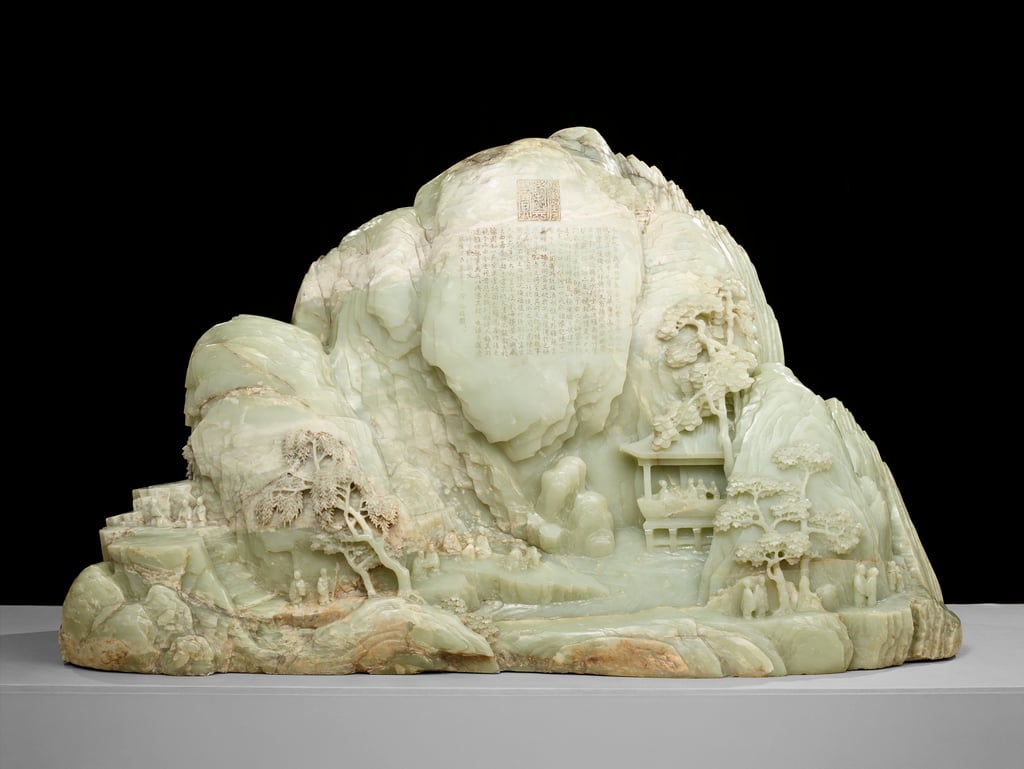
This wonderfully whimsical game was first documented in 353 AD China. The tradition began with poet Wang Xizhi, who invited 41 poets to a banquet. There are two different descriptions of the rules. One states that they would wait by the banks of a stream as cups of rice wine were set afloat. The goal was to compose a poem before the rice wine reached them. Then they’d drink the wine. Mindfulness and no-mind all in one.
The second version states that all the poets would sit on the banks and wait for a cup to stop. Whoever it stopped closest to would drink the cup and write a poem. The end result of this gathering was 37 poems from 26 participants. This appears to be the more likely version to have been played.
The fruits of this first winding stream party survive in Records of the Orchid Pavilion, a classic of Chinese literature which was well known throughout Asia, helping the tradition spread to Japan and Korea, where it is still played today.
Here’s an excerpt from the preface, written by Wang in elegant flowing cursive on cocoon paper with a weasel-whisker brush:
We sit by a redirected stream, allowing the wine goblets to float beside us on its winding course.
Although without the accompaniment of music,
the wine and poem reciting are sufficient for us to exchange our feelings.
On this day, the sky is clear, the air is fresh, and a gentle breeze is blowing.
Looking up, we admire the vastness of the universe;
looking down, we see the myriad works of poetry.
Letting the gaze wander and the mind roam, one can fully enjoy the pleasures of sight and sound, truly a delight.
People’s interactions with each other quickly pass through a lifetime…
As desires fade and circumstances change, grief arises…
…Whether life is long or short, there is always an end….
It is absurd to equate life with death,
and it is equally foolish to think that longevity is the same as the short-lived…
The future generations will look upon us,
just like we look upon our past…
Even though time and circumstances will be different,
the feelings expressed will remain unchanged.
Wang was drunk when he improvised his preface, expressing “the pleasure of encounter, at the same time as melancholy feelings about the fleetingness of life.”
There were corrections and strikethroughs, and the following day, a sober Wang wanted to rewrite the calligraphy to clean it up. Nothing he tried matched the original. Even today, his work is considered a masterpiece, the apex of semi-cursive Chinese calligraphy.
Such is the magic of a fleeting moment and chance encounter, embodied in the chance encounters of cup, stream, poet, ink and paper. Despite the mess of it all, one is able to reach outside of time.
Drink In The Moment
Drinking and games work together to push our minds and bodies towards a flow state, breaking free of the standard inhibitions and boundaries we exist within, pushing us into timeless, liminal states. We forget limitation. We transcend. In doing so, we break down the finite, revealing the all-encompassing infinite.
“There is only one infinite game.”
That’s how James Carse’s little book ends. Play with that, and see where it takes you.




Comments 0
No Readers' Pick yet.