


The Rise of Coffee Beers
 Story by:
Greg Nagel
Story by:
Greg Nagel
I’ll never forget the 2012 Great American Beer Festival. That was the year I went on a four session coffee beer bender in search of the country’s best. Up since 5 A.M., fueled by greasy airport food and adrenaline, I nervously gripped my plastic tasting cup and followed the freshly-practiced bagpipers into the vast, nearly empty festival floor – a good 15 minutes before 12,000 thirsty beer drinkers entered the festival to sample, trample and fart.
Needing a jolt, I stopped at a familiar face, Jon Porter of Smog City Brewing, who at the time was brewing out of Orange County’s Tustin Brewing Company. “Got any coffee beer?” I asked with a junkie’s smile. He nodded, nabbed my virgin cup and filled it full of foam. “Let it settle,” he said knowingly. The beer was Groundwork Coffee Porter, a near-black beer that settled quickly into a cremalike espresso head. One whiff and the words “coffee aromatherapy” are what got jotted down on the first page of my crisp, new GABF media notebook.
Entries into the Coffee Beer category at the Great American Beer Fest have tripled over the past five years.
“This beer has gold written all over it,” I said to Jon, licking my lips of every last drop. “Good luck,” I yelled, skipping away revived.
Coffee beer at the Great American Beer Festival isn’t something one usually thinks of as a popular style, however entries into that category have nearly tripled over the past five years – from 52 in 2010 to 149 last year. Clearly, I’m not the only one with a coffee beer addiction.
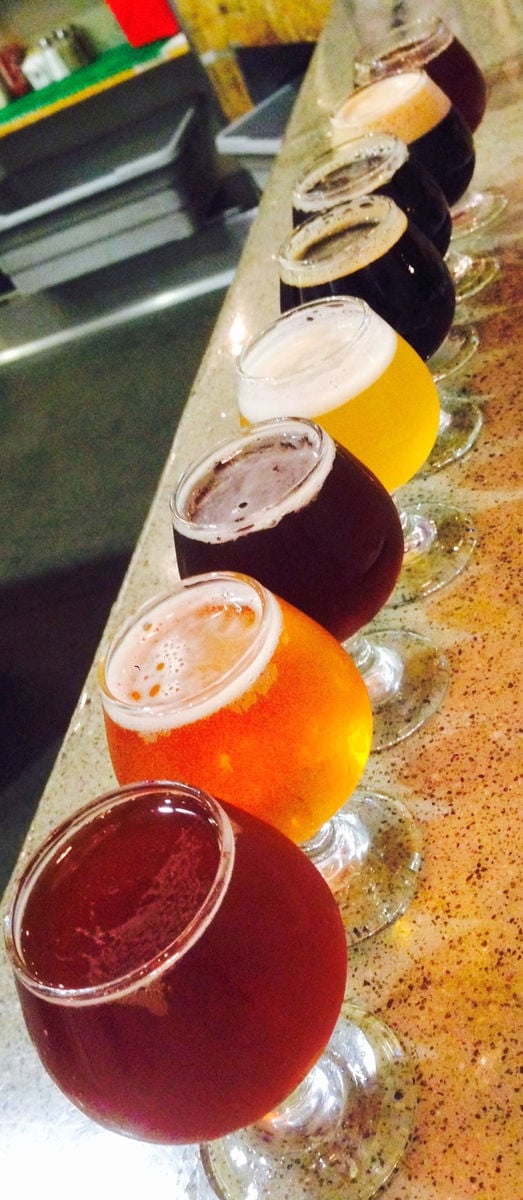
The style was the sixth most-entered category in 2015. Regular old American Stout? Shockingly, that style only featured 39 entries. Perhaps the most telling fact about the numbers is that the top six categories (by number of entries) are all highly aromatic beers, and with that in mind, perhaps it’s no shock that coffee beer is on the rise.
I can almost smell the six most-entered style categories at GABF 2015:
American IPA – 336
Imperial IPA – 208
Wood and Barrel Aged Beer – 179
Session IPA – 161
American Pale Ale – 160
Coffee Beer – 149
What’s the aroma allure?
Science has proven that scent memory is the strongest, most evocative sense that humans have. The smell of freshly cut grass, a stack of new dollar bills, or even sizzling bacon can conjure deep memories of life experiences. To a beer geek, an overripe IPA, a boozy, barrel-aged stout or wet hops at a brewery can trigger daydreams of leisure or thoughts of friends; each sip is a conscious connection to the past.
The aroma of coffee can be even more than that. For many, the smell of coffee can represent numerous things: a ray of sunshine the morning after a rough night, a delightful daytime delicacy, or even something that keeps the midnight oil burning. The aromatic process of making coffee can feel cathartic and ceremonial, and in many cultures such as Ethiopia and Eritrea, it is.
Coffee + Beer = Collaboration
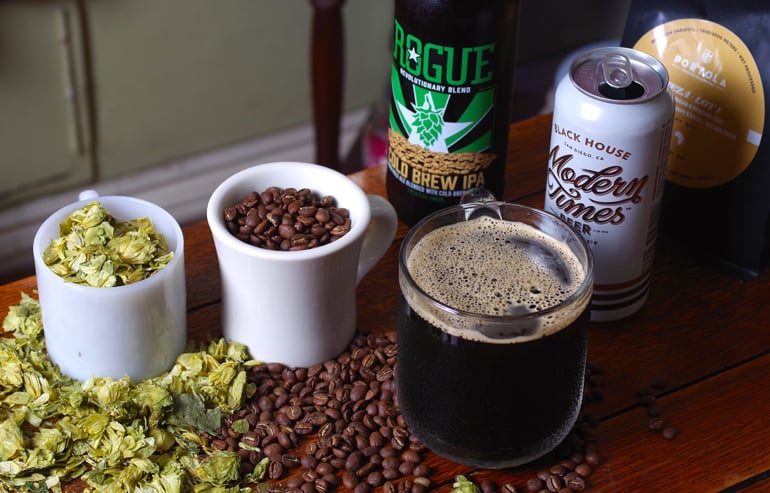
Brewers don’t simply walk into Starbucks and buy a bag off the shelf in order to make a coffee beer. Just how other collaborations are born in craft beer, the relationship with a roaster is critical to nailing nirvana in the glass.
Jeff Duggan, co-owner of Portola Coffee Lab in Costa Mesa has been involved in well over 60 coffee beers. Aside from winning microroaster of the year in 2015, brewers see Jeff as an asset after winning six medals at the GABF and World Beer Cup with Pizza Port Carlsbad and Beachwood BBQ & Brewing. Being a homebrewer himself has enabled him to hone in on nuance while testing intuition.
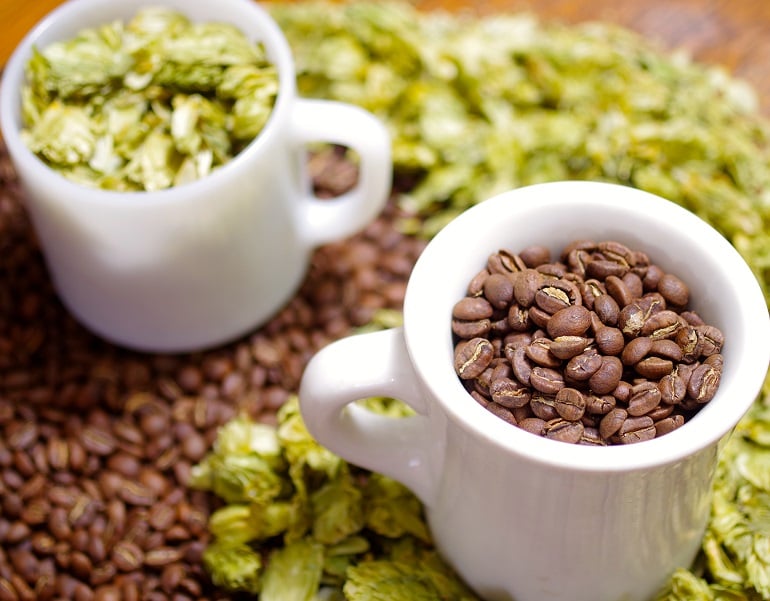
“If the coffee is fresh, it will make a big impact on the end product,” says Jeff. Coffee, like hops, are susceptible to oxidation. Achieving a beer where coffee pops out of the glass relies on timing. Jeff advises using fresh, green coffee beans prior to roasting and introducing those beans to the beer within 10 days. Packaging or serving of the beer also relies on some level of speed to achieve perfection, as coffee aromas fade over time.
But what kind of coffee is right for a beer? From a brewer’s standpoint, a conversation with a roaster should start with a picture of the desired finished product. Does the brewer want a coffee-forward roast bomb? Or does he or she want to create something balanced with a more fruity and delicate coffee presence? Origin, roast level, blend, dosing rate and production method can create vastly different effects in coffee beers.
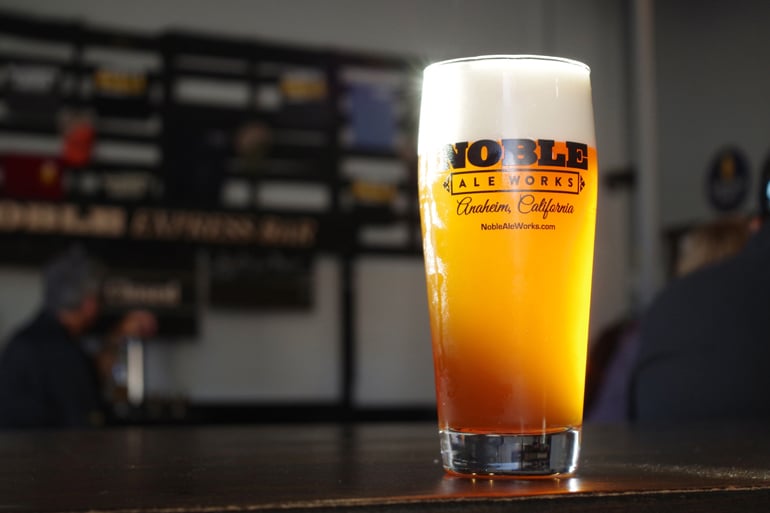
Origin, roast level, blend, dosing rate and production method can create vastly different effects in coffee beers, including color, such as in Noble Ale Works’s Naughty Sauce – a Nitro Golden Milk Stout with coffee.
Not all coffee beers are black
For Evan Price, head brewer at Noble Ale Works in Anaheim, California, a vision of making a beer that “drinks like a super creamy cappuccino” was the inspiration behind “Naughty Sauce,” a Nitro Golden Milk Stout with coffee. “People that don’t necessarily enjoy beer end up loving it; it’s a super-approachable gateway beer,” says Price. Stripping out roasted malt from the beer, the perceived stoutiness comes from the coffee alone. Although fresh batches may have some degree of coffee dust haze, the beer is lighter than a hefeweizen and has more coffee aroma than a 24-hour diner at 3 A.M.
Once Naughty Sauce’s nitro cascade settles, creamy carbonation caps the beer like cupcake frosting, and ends up creating coffee-scented beer mustaches after the first few sips. “We let Portola Coffee Lab geek out with the blend … we know beer; they know coffee,” Price continues. For a special event, Noble brewed a batch of Naughty Sauce using famed Don Pachi beans ($100/lb), which are full of coffee richness and mindblowing aromatics.
Honing in on the grind
Once the origin characteristics are decided on for a beer, the real decisions are made at the cupping table. This is where cold-brew coffee is produced to blend into live beer. At the cupping table, generally three to six bean choices are laid out for evaluation. Pre-grind and post-grind notes are taken, then 200-degree water is added and left to settle for exactly 13 minutes.
With a deepwelled, nonreactive metal spoon, the brulee-looking coffee froth is broken while one inhales deeply with the nose a pinkie finger’s length away from the hot liquid. Raking the spoon back and forth, intense aromas explode into your olfactory receptors, or don’t, depending on the bean. Finally, coffee is slurped loudly off of the spoon with the idea of coating the entire tongue. Flavor, taste, and mouthfeel are evaluated, scores are taken, and a decision is made.
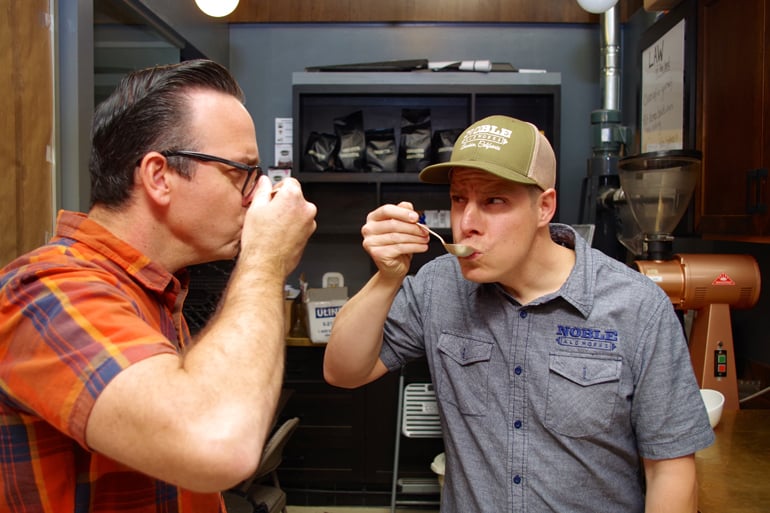
Once the origin characteristics are decided on for a beer, the real decisions are made at the cupping table.
When cupping, the ratio of 8.25 grams of whole bean coffee to 5.07 fluid ounces of water are precisely measured out. The idea is to be exact as possible, leveling the playing field for each cup.
Sean Flannery, brewer at The Bruery and founder of nano-roaster Coldbot Coffee, mentions that the cupping table can be misleading. “Cupping uses 200-degree water to extract the flavor compounds and oils from the coffee. In the beer process, the coffee is cold-steeped anywhere from 34 to 68 degrees Fahrenheit.”
Other coffee beer brewers agree that there are differences in what the cupping table achieves, but it helps evaluate overall quality and how it may fit into the beer’s desired characteristics. “For my coffee beers, I want the coffee to be in symphony with the other flavors and not overly dominant,” says Julian Shrago, brewer of Beachwood BBQ & Brewing’s award-winning Mocha Machine Imperial Porter.
Adding chilled shots of espresso or cold-brew coffee into a pint is yet another method one can use to evaluate, but it may also not necessarily translate to the finished product.
Dosage Best Practice
After the origin, blend and roast are done, it’s time to brew some coffee beer. Post-fermentation, the burr grinder is cleaned and fine mesh bags are filled. For coffeeforward beers, a ratio of one pound of coffee per 10 gallons of beer is used. For the lighter side, one pound per 20 gallons is used. Since coffee extraction is a time-per-temperature equation, on average three days contact time yields the best results. There’s no danger of overextraction. After 24 hours, the beer is pulled off and sampled; if it’s perfect, it’s sent off for packaging.
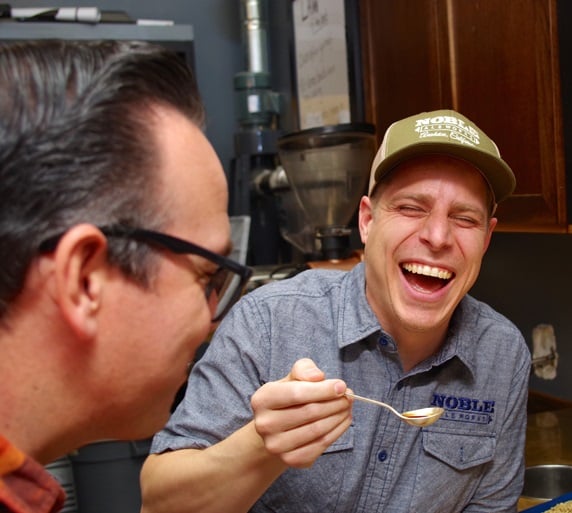
Noble Ale Works head brewer Evan Price has a chuckle after sipping a fresh coffee beer.
Enjoy by?
Furthering the hoppy beer parallels, coffee beer is best enjoyed fresh. When purchasing, it’s best to check the date. Just as a bottle of cold-brewed coffee has a shelf life, time slowly chips away at the volatile aroma compounds found in coffee beers. It’s best to store coffee beer in colder temperatures, and cellaring is highly frowned upon.
If you’ve got the “12-bar blues,” seek out The Brews Brothers, coffee and beer, for a harmonious taste performance guaranteed to get your foot tapping.
Photos courtesy of Greg Nagel.

Comments 0
No Readers' Pick yet.