




Antebellum Ales: Carillon Brewing Company Tour
 Story by:
Kevin Gray
Story by:
Kevin Gray
Ever thought about time travel? If visiting the past were possible, it’s likely that most readers would wander into a pub to try the beer. Imagine comparing today’s beers with their predecessors, discovering how they smelled and tasted.
Time travel doesn’t exist, but one can fly to Dayton, Ohio to delve into beer’s past. Dayton is home to the country’s only historic production brewery, Carillon Brewing Company. Part museum, all brewery, Carillon is a unique product of Dayton History, a non-profit committed to preserving the Gem City’s past. The brewery is the latest addition to the 65-acre Carillon Historical Park, which features buildings and exhibits that date from the city’s founding in 1796 to the present, including one of the Wright Brothers’ flyers.
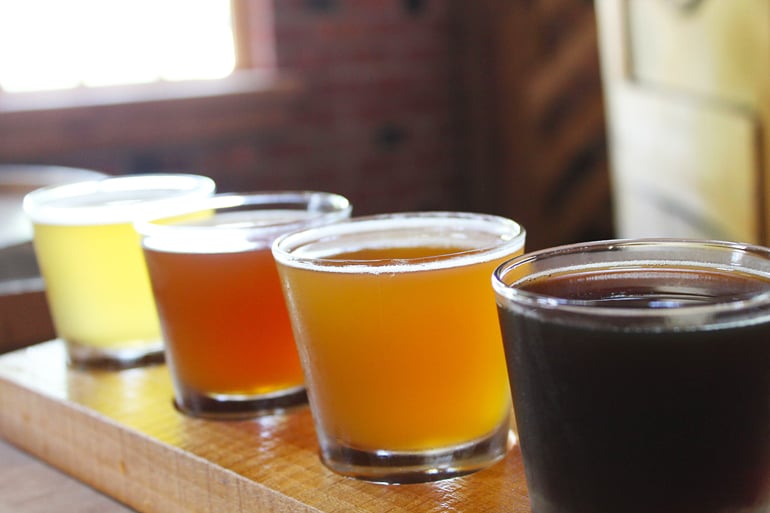
After years of painstaking research into historical construction, brewing techniques, and recipe formulation, Carillon Brewing Company opened in 2014. Brewster Tanya Brock (one of Ohio’s few female head brewers) resurrects historical styles from the 1850s, employing the same processes brewers of that time would have used. Beers such as Coriander Ale, Squash Ale, and Beet Rye ale, as well as a “small beer” that approximates what everyday citizens would have consumed rather than the unsafe, cholera-infected water of that time period, provide an experience unlike any brewery in the country, possibly the world.
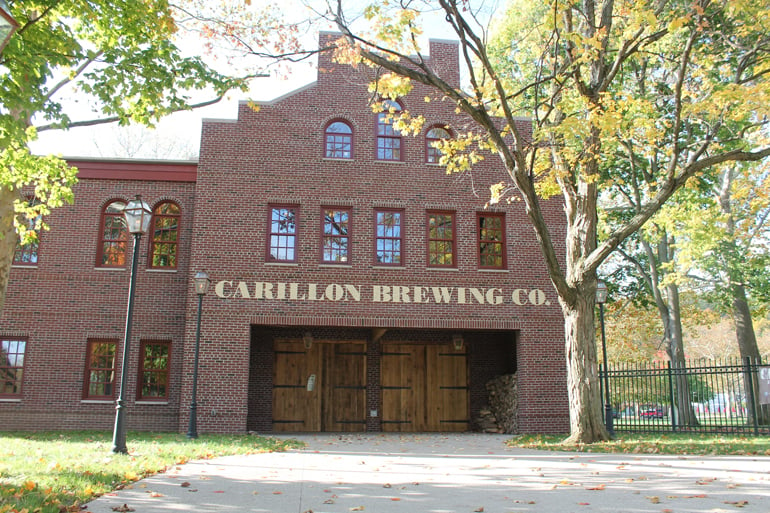
Brewers at Carillon resurrect historical styles from the 1850s, employing the same processes brewers of that time would have used.
The Brewery
The time travel starts with the building itself, which replicates a mid-19th century Midwestern brewery. “Everything from the nails that hold the building together to the food that we serve and the beer that we make takes you back to the 1850s,” describes Brock. All of the details are designed “to give you an idea of not just what beer tasted like at the time and the process of how it was made,” Brock explains, but also to provide “an immersive experience, to let you experience all the sights and sounds and smells and the feeling of what was going on in the 1850s with brewery production.”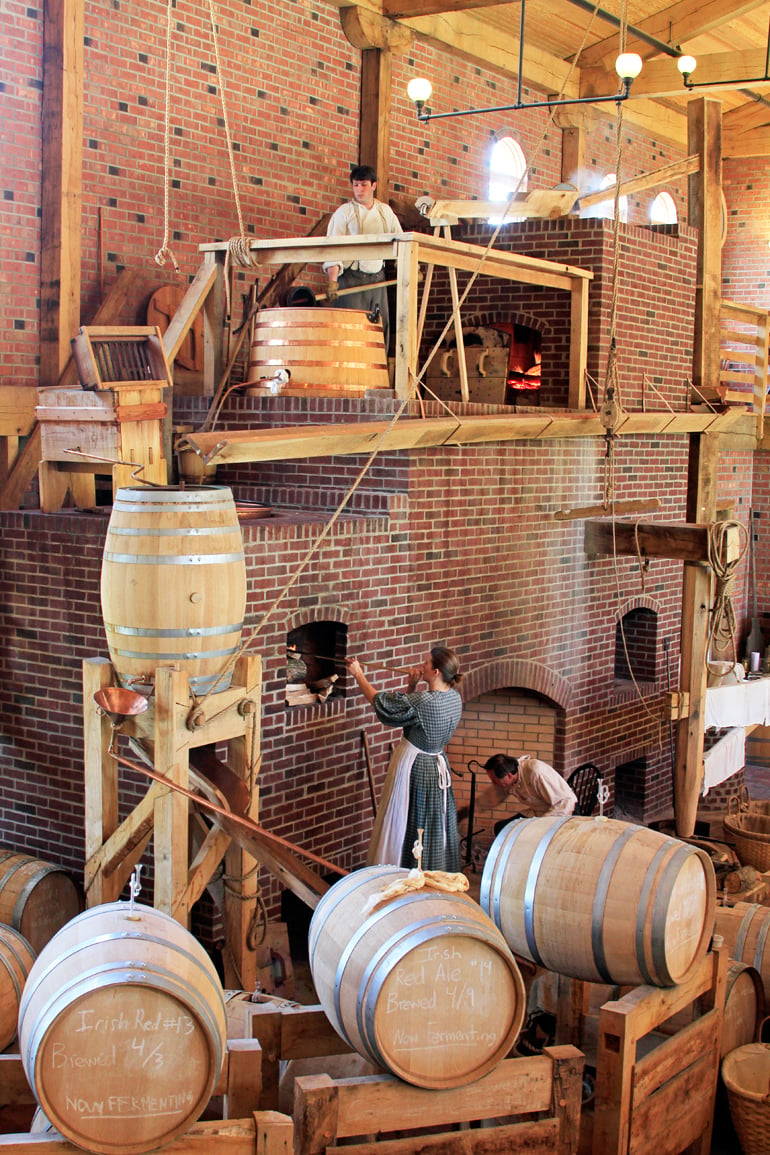
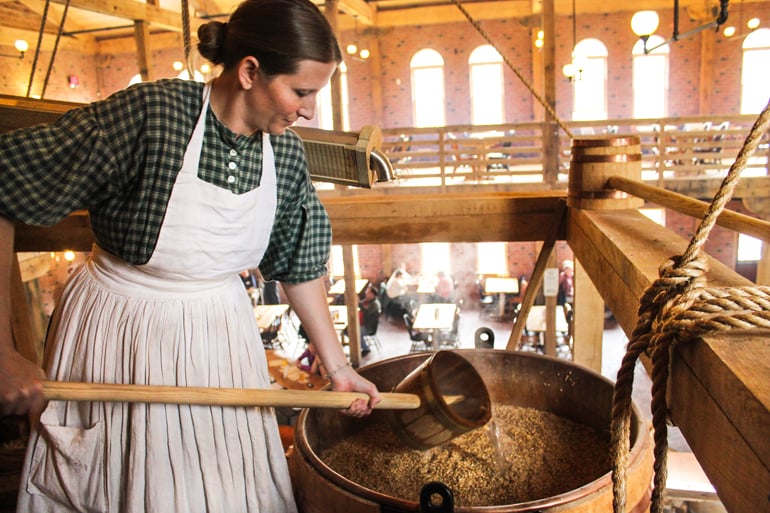
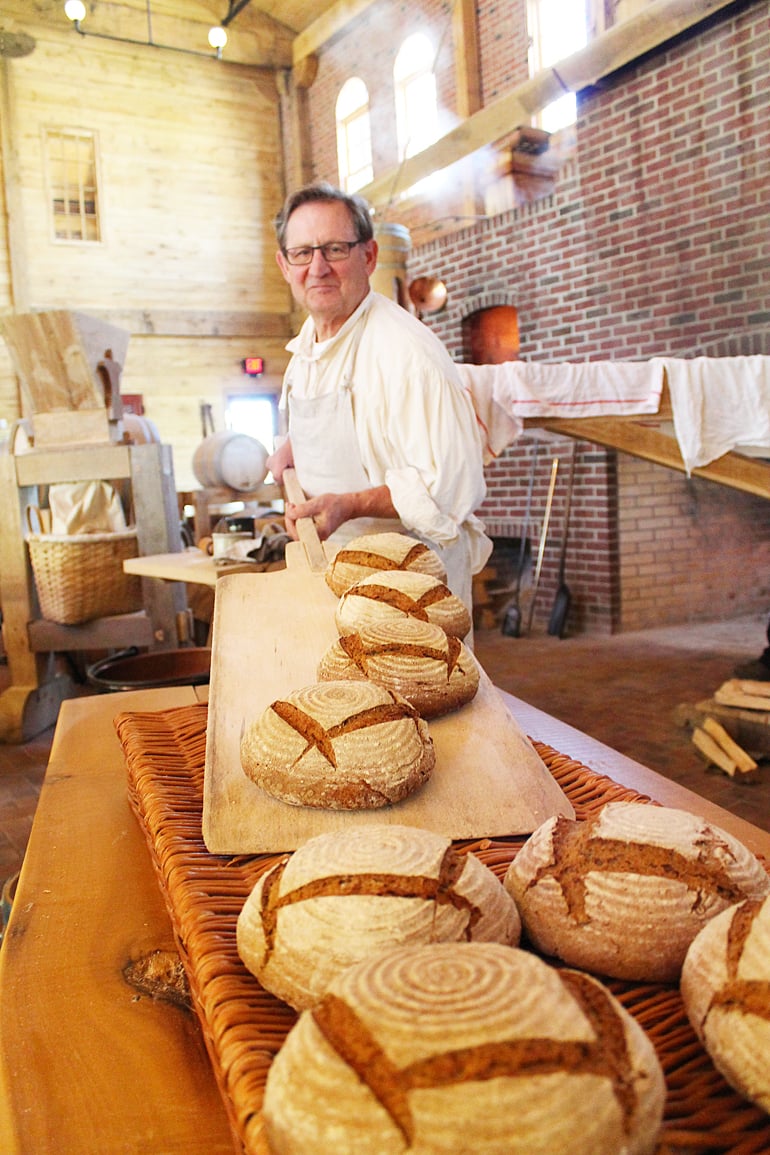
Brock’s brewery achieves its goal, pairing a sensory experience with her historic ales. The first impression is the smell. The beer is brewed over charcoal hearths, and opening the front door yields campfire mingling with the sweet aromas of mashing grains and baking bread. The next impressions are visual. Volunteers in period costumes work the kettles, while others churn butter or tend the fireplaces. The walls are exposed brick and wood, and all of the hardware, down to every visible nail, authenticates the experience.
Volunteers in period costumes work the kettles, while others churn butter or tend the fireplaces. The walls are exposed brick and wood, and all of the hardware, down to every visible nail, authenticates the experience.
A large, three-tiered hearth dominates the main room. One look tells visitors that this is not a modern brewery – there are no stainless tanks, no pumps, and no hoses. Instead, atop each brick tier rests brewing vessels, kettles clad in wood. This system approximates a historic brewing approach that would have spanned multiple floors. Carillon’s system is a cut-away that allows visitors to view the full scale of the operation at once.
As would have been true in the 1850s, Carillon produces beer the really hard way, doing much of the work by hand. Brock explains that the process begins at the top tier, where a charcoal-fired hearth heats strike water. “We start at about 9:30 a.m., bring it up to temperature. Then we hand-ladle it, one gallon at a time, through a trough that feeds into our mash tun, so we can starting our mashing. From there, in that isolated, insulated vessel, the wort will then be drained off. We fly-sparge, so again, one gallon at a time, sprinkling over the top. We lauter right into our boil kettle, which is the third layer. The boil kettle has yet another firebox under it for charcoal and wood fire. We bring it up to a boil, adding the hops at that point.” Then, they flame out, literally shoveling the fire out.
The final steps extend the use of manual labor and gravity. “Then [we] whirlpool in the boil kettle, ladle it once again into our cooling spiral, our cooling barrel,” Brock continues. “That barrel fills with ice-cold water via the long trough in front of the furnace. Hot wort travels through the spiral, and there, at that point, we use the gravity to let it flow into the top barrels to ferment for one week, rack it down into a bottom barrel and condition for two more weeks.”
The Beers
As with the building and the brewery, Brock’s recipes are the product of intense research. “I looked at commercial brewing cookbooks,” Brock explains, “and then also looked at housewife cookbooks and handwritten diaries to find out what are the styles from each of those [sources]. What were the similarities, what were the differences?”
A certified master food preservationist with a degree in cultural anthropology, Brock dove deep into the nature of the recipes themselves: “I looked at the ingredients that they were using, and how that was reflective of the seasonality of those ingredients, where those ingredients would have been grown … going back to the canal and agricultural reports, to find out, ‘Where was the last shipment of spelt in the Dayton area. Or, barley?’… which could help me understand, with the [help of the] Department of Agricultural at Ohio State, what strands of barley they were using. So it wasn’t just, ‘let’s find a recipe and make the beer.’ I knew that the ingredients had changed, so I wanted to find out where those individual ingredients were, what were the species and varietals that they were using, and then find sources that could match that. Or at least be smart enough to say, ‘yeah, I can’t get that anymore but here’s the sugar difference, or here’s the protein value difference.’”
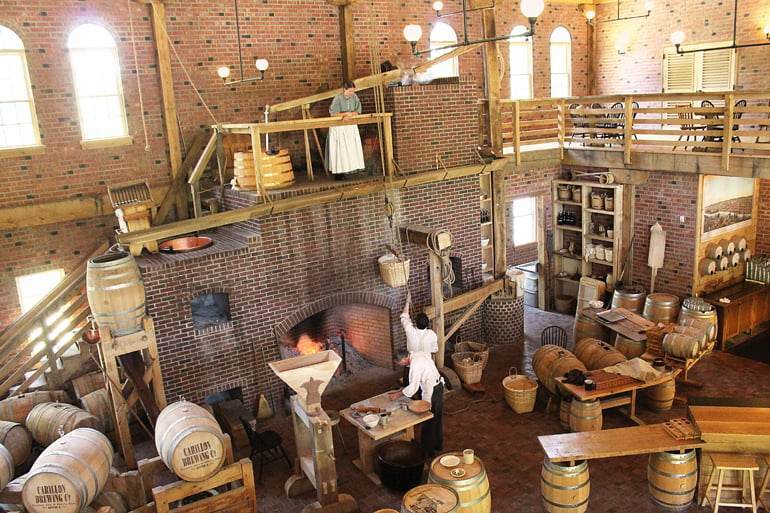
As would have been true in the 1850s, Carillon produces beer the really hard way, doing much of the work by hand.
The building itself also contributes to the flavor of the beers. Despite the old recipes, Brock’s initial batches tasted fairly modern – clean beers fermented with Saccharomyces cerevisiae. Eventually, the ambient flora and fauna, including Brettanomyces, lactobacillus, pediococcus, started finding its way into the beer and changing its flavor. Because these flavors are true to the historic style, Brock made a conscious decision not to fight it. “I could control it, but then I would be a modern brewer,” explains Brock.
The History
 Modern craft breweries are nothing new to Ohio, which has seen exponential growth of craft breweries in the last five years. But a brewery museum is one of a kind. How did it come to be? And why pick the 1850s? Brock explains that “1850 was a turning point for many, many stories.” It was a time of change for the Miami Valley, as residents moved from homesteads into cities and towns, and German and Irish immigrants started settling in the area. Industrialization and commercialization were starting to take root, consolidating jobs typically done in the home, including beer brewing.
The beer, and the restaurant’s historic food, allows the museum to show how “one little thing is relevant and impacted by so many different points of history and innovation and science.”
This time period, Brock explains, “gave us several points of conversation to use the beer as a hook, [to] get people in here because that’s an easy sell.” Brock notes that the beer, and the restaurant’s historic food, allows the museum to show how “one little thing is relevant and impacted by so many different points of history and innovation and science.”
The time period also filled a hole in the structure of Dayton History’s Carillon Historic Park. In 2007, Brady Kress, Dayton History’s Director, was updating the master interpretive plan for the park and realized that there was more demand for an expanded restaurant.
“I’m a fifth-generation Daytonian of German-Catholic descent,” Kress explains. “My family has made wine since arriving in Ohio in 1841, and my grandparents brewed beer at the house. As I’ve developed stories and grown Carillon for the last dozen years, I have always been attracted to telling Dayton’s stories of beer, wine and spirit production. I first put a brewery in our master plan for the museum in 2007. As we looked at our expanding audience, we knew they were demanding more hands-on, unique, production-type experiences … I determined it was time to pull the trigger on this project. A historic, full-scale operating brewery with everyone in costume using historic tools and techniques. The first and only museum in the country to do so; where guests could watch the historic methods, taste the product, and then buy it and take it home.”
Thanks to gifts from Heidelberg Distributing Company, Rieck Services, Schiewetz Foundation and other donors and the historical research led by Brock and her team, the plan worked. The brewery just celebrated its first anniversary, and continues to grow and find new ways to engage the public, including food and beer tastings and “brewer for a day” opportunities. “I’m so pleased that our brewery has been well received by the public,” Kress explains, “that it has provided a good authentic understanding of the brewing process, and I hope my grandparents, who are buried less than 700 yards from the brewery, would be smiling.”
Carillon Brewing Company is located at 1000 Carillon Boulevard; Dayton, OH 45409 and is open daily from 11:00 am to 10:00 pm. Call 937-910-0722 or find them online at http://www.carillonbrewingco.org for details and to plan your visit.
All Photos Courtesy of Carillon Brewing Co.
Conversations (0)
No comments yet.