


European Beer News (Issue 19)

 Story by:
Editorial Dept.
Story by:
Editorial Dept.

by Carl Kins
 Dubuisson, Duvel Introduce New Beers
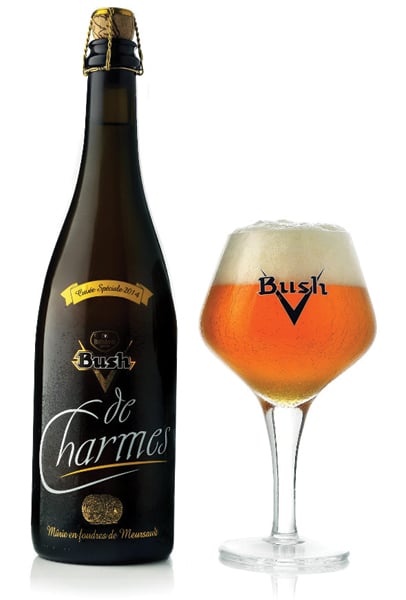
Two major brands have introduced new beers. Dubuisson has launched Bush de Charmes, a barrel-aged beer made by placing Bush Blonde in oak barrels previously used to store the Charmes Meursault white burgundy wine.
Duvel is making a beer with wild yeast to be sold at its Brewery De Koninck in Antwerp. The company is currently enhancing De Koninck as a destination for Belgians and international visitors, scheduling a name change to Antwerp City Brewery this summer. The Stadsbrouwerij buildings will include a restaurant, chocolatier, cheesemonger and butcher. The wild yeast beer will also be available at The Jane in Antwerp, located in a converted church. It is run by starred chef Sergio Herman, this year’s Beer & Gastronomy Ambassador, a position created by the Beer Society of the Low Countries.
Duvel continues to be creative in all fields. It has now added “APA” to the label of its normal De Koninck, which stands for “Antwaarpse Pale Ale.
Expansion Continues
Plenty of new brewers are seeing the light. The Viven beers, contract brewed at De Proef since 1999, are now brewed at the company’s facility in Sijsele. A 17th brewery in the Luxembourg province has opened, called La Brasserie d’Oster. In September, Brouwerij Het Nest will open in Turnhout, claiming an investment of $2.4 million. The rumor mill says about another 10 breweries will open by the end of the year.

by Max Bahnson
Micros On The Rise
Things are going very well in the microbrewery sector. The number of microbreweries increased 25 percent, reaching 280 in 2014. Overall production was up by 30 percent.
Two years ago, the Czech Association of Micro-Breweries estimated that the market didn’t have room for much more than 250 breweries. Reality has forced a review on that forecast, and now the organization has estimated the limit to be 400. Other specialists, however, believe there could be even more opportunities for microbrewers. Since microbreweries, new or established, are still predominantly brewpubs, any town or neighborhood that can support a big enough restaurant or pub could very well have its own brewery.
Although the Czech Brewers and Maltsters Association has yet to announce the official industry figures for 2014, the first available estimates indicate a year very similar to the previous one – a slight growth of not much more than one percent.
Some breweries have already announced their own figures and they look positive. With 4.5 percent of the market, Plzeský Prazdroj had its biggest year-over-year production growth since the end of the 2010. For the Budjovický Budvar and Bernard brands, 2014 was another record year.
Other regional breweries have also reported positive figures. Among them is Pivovar Ferndinand from Benešov, whose on-trade sales from taps in pubs – a much more profitable segment – grew by eight percent.
It was in fact on-trade sales that contributed to Prazdroj’s successful year, according to Paolo Lanzarotti. The General Director of the biggest brewing company in the country attributes the growth to a campaign to bring people back to pubs which was launched in 2013.

by Jim Dykstra
Beer Fountain of Youth
Claiming unique health benefits, Klosterbraueri Neuzelle wants to introduce a beer it claims will slow the aging process. The Neuzelle brewer say its Bathbeer contains vitamins, minerals and spirulina, an algae, that provide these extra benefits. The rejuvenation, it is claimed, can also be achieved through dabbing it on the skin.
The Reinheitsgebot, however, may prove a big hurdle since it calls for only barley, water, hops and yeast to be used in the brewing of beer and remains the oldest food law in the world. The question is scheduled for adjudication, which may result in the product being released in Germany as something other than beer.
In addition to Germany, Bathbeer (4.8% ABV) is scheduled for release in the United States, Poland and South Korea.
 German brewers scored one for the Reinheitsgebot after winning government backing to protect their water supplies from fracking.
The government will allow federal states to identify “no-fracking zones” to preserve the quality of ground water used for making beer and bottled mineral water. “We need clean water to produce our beer,” said Friedrich Duell, president of the Bavarian Brewers Association. “If our wells aren’t protected our business is threatened.”
“Fracking is a high-risk technology and we’ve seen water tainted in other countries often enough,” said Duell, whose 350-year-old brewery in Krautheim in the south German region of Franconia operates two wells.

by Carolyn Smagalski
Welsh brewery Celt Experience expects to double in size within the year, due to international demand for its highly “experimental and strange” craft beers. Exporting to 20 countries, owner Tom Newman rides the leading edge in markets that include Sweden and the U.S. where experimental and strange comes with the promise of success. Adding to a base of 15 core beers and three wood-infused big beers, Celt Experience has collaborated with beer celebrities in both the international and local arenas, including Boxing Cat of Shanghai, Ale Syndicate and Atlas Brewing of Chicago, BrewDog of nearby Scotland, rock band Super Furry Animals, and Simon Martin of Real Ale Today.
Searching for Free Beer?
In Ireland’s County Cork, the 9 White Deer Brewery of Múscrai Gaeltacht has your back. The one-year-old brewery cornered the Irish market with Saor, Ireland’s first locally crafted gluten-free beer. Saor, which means “Free” in the local gaelinn language, was developed by brewer and co-founder Gordon Lucey without the use of sorghum or buckwheat. He developed an innovative process of denaturing the gluten in barley malt to yield a softly hopped, drinkable beer with certified gluten levels below 20 parts per million.
In January 2015, eight Scottish brewers formed the Brewers Association of Scotland. Its membership aspires to grow the craft beer industry beyond the current $46 million mark by tapping local resources and through innovation and collaboration.
Scotland’s barley community is abuzz with a $35 million International Centre for the Science of Barley said to be on the way, including on-site microbreweries and microdistilleries to monitor the use of newly developed strains of barley in beers and spirits.
Comments 0
No Readers' Pick yet.