


Vienna Lager and Extra Special Strong Bitter / ESB
 Story by:
Owen Ogletree
Story by:
Owen Ogletree
For our Fall Issue, Owen Ogletree provides the telling details behind two well traveled beers that may move around but have never gone out of style.
It was Owen, himself an intrepid voyager, who once observed you had to go to Mexico or Cleveland to get a classic Vienna Lager. But that’s no longer the case. In a revival that is notable for an emphasis on balance, moderation and taste, quite a few American craft brewers have chosen to include a Viennese lager in their portfolios.
Should you find yourself in a Mexican restaurant with no American craft in sight, check out the Negra Modelo for a taste of Vienna – and some Napoleonic history – that pairs well with enchiladas.
If a taste of London is what you’re looking for, it’s a bit easier to tap the source. Extra Special Strong Bitter, or ESB, is readily available as an import from London as well as from American craft brewers. It’s the balance of malt, hops and alcohol in this so-called bitter that make it a classic.
Vienna Lager
The story of Vienna Lager began in 1841 when brewer Anton Dreher of the Schwechat Brewery in Austria used his kilns to lightly roast a new type of pale malt that produced beers with a pale color, light notes of toast and a soft, elegant, sophisticated flavor profile. Dreher’s malt took on the name Vienna malt, and the novel brew followed suit with the moniker Vienna Lager.
Jump to France in 1864 — Napoleon III declared Maximilian I, an Austrian Habsburg, emperor of Mexico. Maximilian moved to Mexico and took along quite a collection of Austrian brewers, each of which brought a love for this lager from Vienna. After only three years, Mexico’s Benito Juarez led a revolution that overthrew the European leaders and executed Maximilian. For obvious reasons, the Austrian brewers had become valued members of the community and were allowed to continue production of their lager and shape the future of the beer industry in Mexico.
Although Schwechat was the largest brewer in the world at the turn of the 20th Century, the pilsner styles soon gained enormous popularity in Europe and Vienna Lager fell out of favor in Austria and the rest of the continent. These days, searching Vienna for a true Viennese-style lager will lead to serious frustration on the part of any uninformed craft beer aficionado. To taste current interpretations of the style, one must now look mainly to Mexico or to numerous American craft breweries and brewpubs. As they have done with many rare, historic beer varieties, American brewers researched the Vienna Lager style and helped resurrect the beer here at home.
A classic Vienna Lager displays colors of ruddy amber/copper to an almost ruby-hued brown. This is a polished, cold-conditioned lager that should be quite clear with no chill haze or sediment. The beer should be topped by a substantial, off-white layer of foam with impressive head retention.
Schwechat was the largest brewer in the world at the turn of the 20th Century. But the pilsner styles soon gained enormous popularity and Vienna Lager fell out of favor in Austria and the rest of the continent.
Compared to a classic Oktoberfes/Märzen, a Vienna Lager should waft moderate, more restrained aromas of complex, Vienna and/or Munich malts — with an appealing toasted malt note often backed by just a hint of biscuits. Low noble hop presence comes through as a trace on the nose, and fruity esters and butterscotch-like diacetyl should be absent completely. Brewers also try to avoid sweet caramel aroma and flavor in the style.
Along with light malt sweetness in the flavor profile, a classic Vienna-style lager contains a toasted, melanoidin-focused, Vienna malt character and just enough floral, noble-type hop bitterness to provide a crisp, somewhat dry, well-balanced finish. Hop flavor and bitterness can be low to moderately low. Caramel and dark malts may be used to add color and body, but caramel malts shouldn’t contribute to aroma and flavor, and roasted malt notes from dark malts are usually avoided.
Lager yeast, which was isolated around the same time that Vienna malt was first produced in the 1800s, thrives in cold temperatures and ideally produces beers with no perceptible fruity esters that are common with lively ale yeast strains employed at warmer temperatures. Vienna-style lagers definitely should exhibit this clean lager profile — with corn-like DMS, butterscotchy diacetyl and spicy phenol compounds always absent.
When swirled around the palate, a well-made Vienna Lager should impart a medium-light to medium mouthfeel with a soft, pleasant, creamy sensation that comes across as not sweet or too toffee-like when swallowed. Carbonation should be moderate and on par with a typical Oktoberfest, Munich-style dunkel or helles lager.
Pairing food items with this versatile lager style is not challenging. Of course, Mexican dishes like enchiladas, fajitas, chili rellenos and even red menudo are a no-brainer with a Vienna-style lager. The crisp, toasty character of the beer also make a lovely complement alongside pizza, fried fish, sausage, roast pork, grilled vegetables, smoked trout, caramel flan and jalapeño jack cheese.
Exquisite Vienna and German-type lager malts form the framework of this classic style that’s so often overlooked and taken for granted by lovers of modern, extreme craft beers. Vienna-style lagers take time, effort and concentration to appreciate, but their enduring presence in our 21st Century beer culture is verification of their elegant allure.
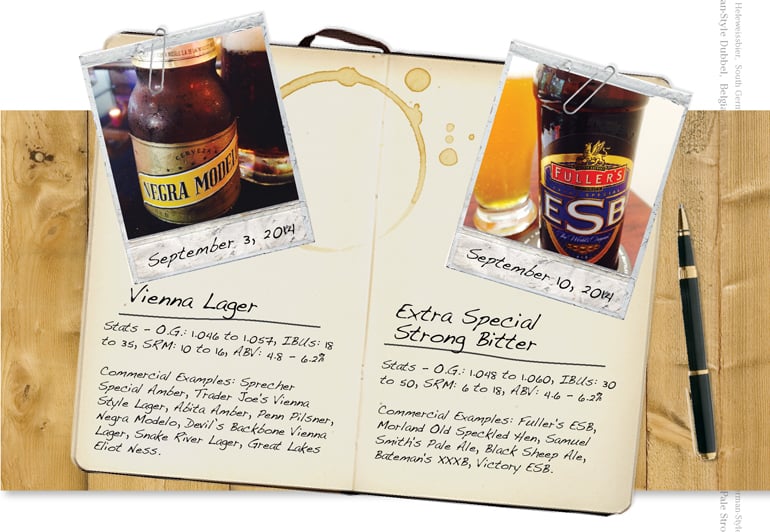
Statistics:
O.G.: 1.046 to 1.057,
IBUs: 18 to 35
SRM: 10 to 16
ABV: 4.8 – 6.2%
Commercial Examples: Sprecher Special Amber, Trader Joe’s Vienna Style Lager, Abita Amber, Penn Pilsner, Negra Modelo, Devil’s Backbone Vienna Lager, Snake River Lager, Great Lakes Eliot Ness.
Extra Special Strong Bitter
A beer lover from America lands in London and walks into a recommended cask ale pub where he heads directly to the bar to eye the colorful pump clips. His mouth begins to water as he spies Fuller’s ESB. After ordering a pint, he asks the patron standing next to him if he has ever tried the ESB. “That’s a really tasty beer,” the patron replies. “But it’s very strong and goes right to my head.”
It’s really a matter of perspective. Brewed at 5.5 percent ABV in cask and 5.9 percent ABV in bottle, Fuller’s ESB would hardly seem like a strong beer to some American craft beer lovers these days, but ale drinkers in the UK are more accustomed to quaffing English bitter that’s lighter in alcohol. Ales that come in at 3.2 to 3.8 percent ABV are commonly known as “standard” or “ordinary” bitter. “Special,” or “best” bitter, falls into the 3.8 to 4.6 percent ABV span, while 4.6 to slightly over six percent versions are termed “extra special” or “strong” bitter. Often, an English brewery’s three classes of bitter are basically the same recipe — with the strong bitter coming from the concentrated first runnings of the wort, and the best and ordinary bitter fermented from the later, weaker liquid — after rinsing of the mash grains with hot water begins. The three beers can then be made more distinctive with additions of different hops in the boil and dry-hop stages.
Most of the hops in a true English ESB are U.K.-grown. The term “English bitter” causes some hop-inhibited drinkers to shy away from the style, but experienced drinkers will describe an ESB as malt-centered and not very bitter at all.
The “ESB” in the renowned Fuller’s brand stands for Extra Special Bitter, and the historic Fuller’s brewery in Chiswick holds a trademark for the term ESB in the United Kingdom. The trademark doesn’t apply to brewers in other countries, so ESB is frequently a part of names for American versions of the style.
Most of the hops in a true English ESB are all UK-grown, with the majority being added at the beginning of the boil to provide a balancing, yet not overly aggressive, bitterness. The term “English bitter” causes some hop-inhibited drinkers to shy away from the style, but experienced drinkers will describe an ESB as malt-centered and not very bitter at all.
When asked why the ESB style is so appealing to beer drinkers around the world, John Keeling, the brewing director at Fuller’s, replies, “There is a good balance between sweetness and bitterness — between the malt and the hop character. This gives excellent drinkability for a beer of its strength. In our version, the typical fruity, orange quality of Fuller’s yeast adds interest and complexity to the balance.”
A typical English-style ESB will be bursting with aromas of fruit esters, toffee, caramel malt and medium to medium-high UK hop levels. While American hops usually offer notes of pine, grapefruit and/or pineapple, UK hops are characterized by more restrained, earthy aromas and flavors of wood tannins, resin, flowers and spice. Overt American hop notes are not appropriate in an English-style ESB, and butterscotch character from diacetyl should be absent or extremely low.
Pale Ale and Crystal malts highlight the grain bill of an ESB. A pleasing caramel sweetness and biscuity malt layer usually accompany a moderate to moderately high hop flavor and bitterness that linger on the finish – but do not dominate the malt complexity or medium-light to medium-full body. Some modern, golden versions of ESB are brewed exclusively with pale malt and lack caramel character.
When holding an ESB to the light, expect a bright ale with a golden to deep mahogany shade. Cask-conditioned versions in the pub usually have a low level of carbonation with a slight head, while bottled varieties are livelier.
Appropriate food pairings to complement an ESB include almost any dish with a caramelized character. Think of seared meats, grilled salmon, liver with onions, fish and chips, bacon burgers, meat pies, French onion soup and crème brûlée. The malt character of the beer melds beautifully with the browned sweetness of the caramelized food, and the bite of the beer’s bittering hops makes for a delightful contrast that resets the palate for the next mouthful of food.
Statistics
O.G.: 1.048 to 1.060
IBUs: 30 to 50
SRM: 6 to 18
ABV: 4.6 – 6.2%
Commercial Examples: Fuller’s ESB, Morland Old Speckled Hen, Samuel Smith’s Pale Ale, Black Sheep Ale, Bateman’s XXXB, Victory ESB.

Comments 0
No Readers' Pick yet.