



A Beer Ahead of Its Time: The Legacy of Samuel Adams’ Millennium
 Story by:
Eric Griffin
Story by:
Eric Griffin
The fall of 1999 marked the moment when Samuel Adams challenged everything drinkers thought they knew about beer. Samuel Adams Millennium wasn’t just another limited release. This was a statement that sought to prove that beer could be as ambitious, complex and impactful as the world’s finest wines and spirits.
And yet, despite its significance, Millennium quietly faded from the conversation.
In today’s craft beer landscape, double-digit ABV beers, collectible presentations, and extensive barrel aging and blending have become relatively commonplace. If you rewind to November 1999, however, none of this was normal. Millennium challenged long-held assumptions about what beer could be, not only as a beverage but as an experience. It was a statement of innovation. This article is an opportunity to revisit that legacy. We’ll explore the story behind one of the most influential beers of its era and examine the impact it had on the evolution of craft brewing. Finally, after more than a quarter-century in the bottle, we’ll be opening MMM ourselves to discover how one of beer’s greatest experiments has stood the test of time.
The Brewery Built for the Future
By the time 2000 was rolling around, Samuel Adams had been around for about fifteen years. The Boston-based company had been a huge catalyst for the modern American craft beer revolution, with its famous Boston Lager taking the country by storm in 1985. Within six weeks of its Patriots’ Day debut, Boston Lager had already been voted the “Best Beer in America” at the Great American Beer Festival, validating Koch’s belief that quality over advertising would ultimately define the brewery. It was like nothing else on the market at the time, and consumer demand continued to surge. Jim Koch’s vision was coming to life much more quickly than he had anticipated.
Before his eyes, he was watching the business outpace the five-year plan he had originally envisioned. But getting there took immense work for the Samuel Adams founder, and going in, the odds weren’t in his favor. All five beer distributors in Boston rejected the beer, leaving Koch to build the brand the only way he knew how: one account at a time. He personally pitched the owners, the managers and the bartenders, convincing the people pouring the actual beer that the product was worth it. It was a refreshingly simple approach, but one that focused on education and quality. Most importantly, Koch never lost sight of the lesson passed down by his father, a fifth-generation brewer:
“People drink the beer; they don’t drink the marketing.”
This philosophy—one that prioritized brewing excellence over advertising budgets—allowed Samuel Adams Boston Lager to earn its reputation with every pour and helped fuel one of the most successful stories in American craft beer. But looking forward, it became time to move beyond the startup brewery mindset. Having quickly become one of the defining names of the craft beer movement, Samuel Adams was ready to tackle a different question: How far could beer really go?
Brewing for the New Millennium
To understand why Millennium felt so radical in 1999, it helps to remember just how different the world, and the beer landscape, looked at the time.
The Technological Backdrop
For those of you born after the turn of the century, it’s important to note a few things about the state of the world in 1999. First and foremost, the internet was still largely dial-up, and social media platforms didn’t exist. Instead, news spread through magazines, newspapers and message boards. Not only that, but people genuinely wondered if computers would even still function once the calendars rolled over to the year 2000.
As part of the Y2K hysteria, people worried that because computer programmers used two-digit codes for years (e.g., “99” for 1999), computers would misinterpret “00” as 1900 instead of 2000, potentially causing critical computer-based systems to crash. In short, there was a significant amount of uncertainty around what the new millennium would bring.
That being said, there was also plenty of excitement. Every major company was releasing some form of “Millennium Edition” product, and the craze ran rampant as anticipation mounted. But what Samuel Adams introduced to the world was something very different.
Setting the Stage
As the turn of the century approached, Samuel Adams had clearly evolved far beyond the brewery that launched Boston Lager just fifteen years earlier. While its lineup of brews had expanded with seasonal offerings and the occasional specialty release, the reputation it had built was firmly rooted in classic, high-quality styles. Innovation was always a part of Jim Koch’s philosophy, but the brewery was never trying to chase extremes just to make headlines. It wasn’t until 1993 that the Boston team decided to shake things up.
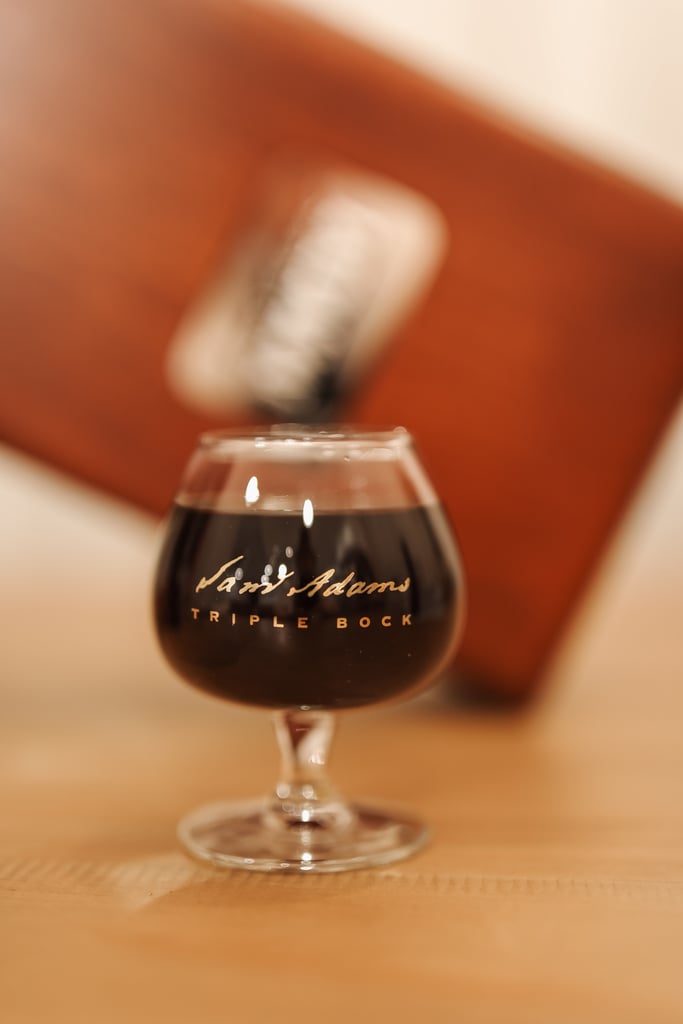
That year, the brewery introduced Triple Bock, a beer that was unlike anything most beer drinkers—certainly those based in the U.S.—had ever seen. At roughly 18% ABV, it was billed by Samuel Adams as the strongest beer in the world at the time. It challenged everything about what beer could be—rich, syrupy and almost like a liqueur. Drinkers were torn, critics were intrigued, and above all else, it proved that there was, in fact, an audience willing to explore the limits of what brewing could achieve. But more importantly, it established a foundation for Jim Koch and his team.
Rather than being the finish line, Triple Bock was simply the starting gun.
The Release
All the subsequent questions of “What’s next?” ultimately led to Millennium. Released in November 1999, Millennium was so much more than another “Millennium Edition” special release like so many other brands were producing. This was Sam Adams’ follow-up “Extreme Beer” to Triple Bock.
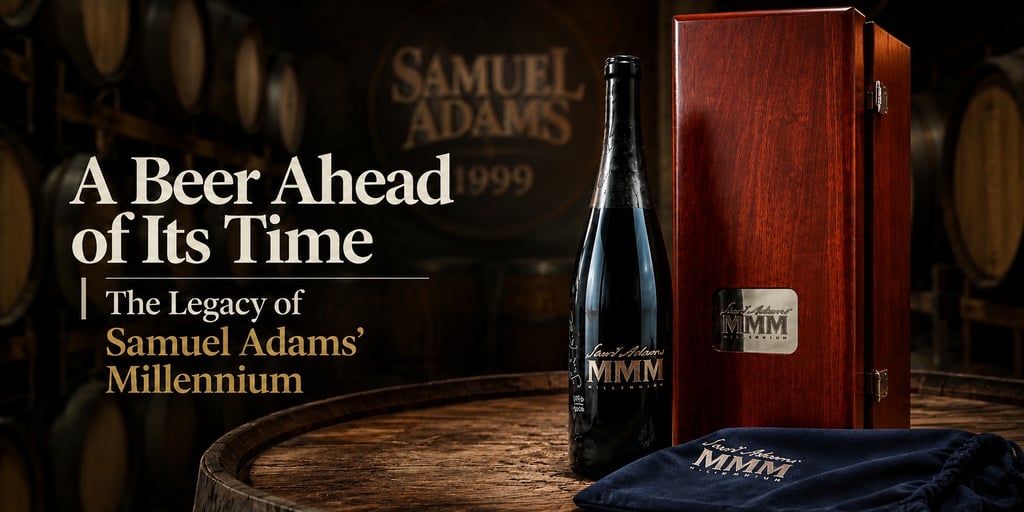
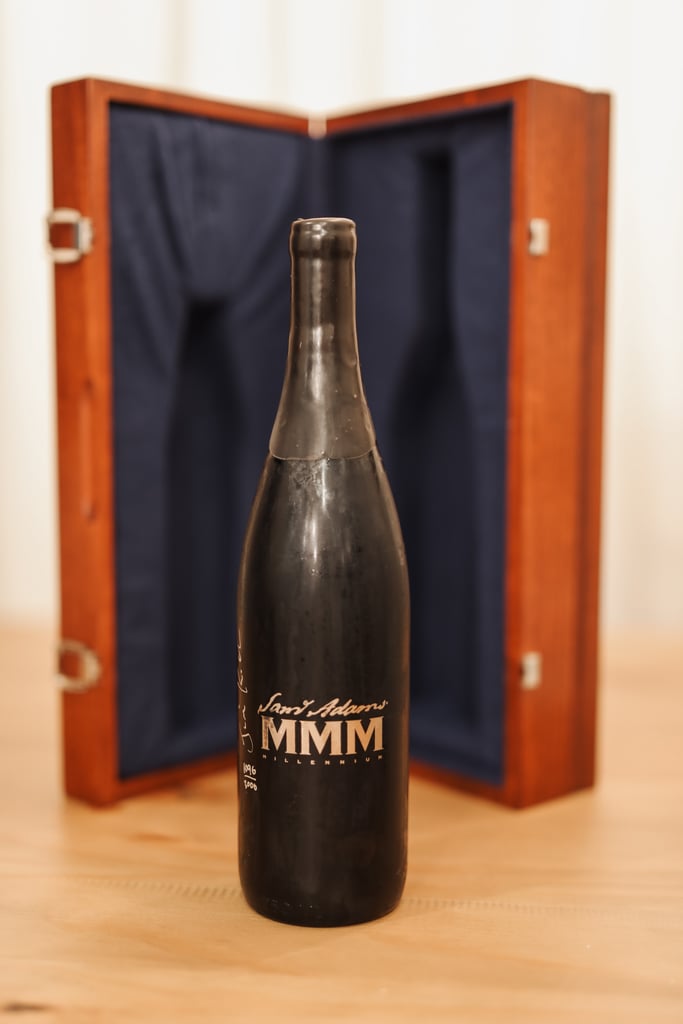
The entire run consisted of only 3,000 bottles, each numbered by hand and signed by Jim Koch himself. The bottles were then corked, waxed and presented in handcrafted cherry wood cases cushioned and lined with blue felt. Bottle number 1/3000 was auctioned just before the new year for an incredible $4,910, with all proceeds benefiting the Colorado Outward Bound School nonprofit program.
The response to the beer exceeded the brewery’s expectations, with its team commenting that they wished they had reserved more bottles for other charitable opportunities. Paying nearly $5,000 for a beer—even one for charity—was almost unimaginable at the time, and this was a clear hint that Millennium was not just another beer.
As the world prepared to celebrate the new millennium and so many brands across countless industries rushed to release commemorative products, the Los Angeles Times even published a piece on what to look out for. Among the products featured was Millennium—not alongside other beers, but among limited-edition Cognac, Champagne, Port and Bourbon releases. It was official: Samuel Adams had succeeded in placing beer into an entirely new conversation, with Millennium becoming one of the earliest beers to find itself in this kind of company.
A New Millennium
Triple Bock made many drinkers ask just how strong a beer could become. Millennium took that question to the next level.
On paper, the recipe is surprisingly restrained. Put simply, Sam Adams took traditional brewing practices and pushed them to extraordinary extremes. The grist combined two-row pale malt, Vienna malt and caramel malt, helping provide the underlying sweetness required to support a beer with such a high target ABV. The hop bill utilized the four traditional “Nobles”—Hallertau Mittelfrüh, Tettnang, Spalt and Saaz—and helped balance that immense malt character with a firmer, spiced bitterness. However, some of the ingredients that drew the most attention were the additional fermentable sugars, including maple syrup, honey and cane sugar.
These weren’t added just to layer the flavor profile. Instead, they provided additional sources of fermentable sugar, allowing the brewing team to push the ABV beyond what a malt-exclusive wort could realistically achieve while also keeping the beer from becoming too heavy. However, pulling off Millennium required solving an even bigger issue.
When trying to brew a beer with a double-digit ABV, traditional brewing yeast begins to reach its limits. Boston Beer brewmaster Grant Wood spent years cultivating an alcohol-tolerant yeast strain that could survive these conditions and overcome this barrier. Conducting numerous experiments at the Jamaica Plain brewery, the team gradually refined both the techniques and its understanding of yeast physiology that made brewing Millennium possible. Achieving roughly 21% ABV through fermentation alone was an incredible feat at a time when reaching that strength without distillation or freeze concentration was extraordinarily difficult.
Millennium’s complexity also came from techniques that would become central to later Samuel Adams extreme beers. The beer was aged in bourbon barrels and incorporated a portion of Triple Bock into the blend, directly connecting the brewery’s first extreme-beer experiment with what would eventually become Utopias.
And thus, MMM was born.
It was unlike any other beer that had come before it. Bottled in cobalt blue, corked and waxed, its unique and beautifully presented packaging was anything but accidental. This was a clear reflection of exactly how Jim Koch hoped people would experience Millennium: pour by pour, shared among friends and savored like a fine spirit or vintage Port. And perhaps most importantly, it was designed for aging.
The Experience: 26 Years Later
More than a quarter-century later, it was finally time to see how Samuel Adams’ extreme-beer ambitions had held up in the bottle.
Unboxing
The tasting didn’t begin with the first pour. It began with the first sound. The dull click of each toggle latch echoed through the room as MMM’s cherry wood case gave way. Twenty-six years after it was originally enclosed, Millennium was about to see daylight again.
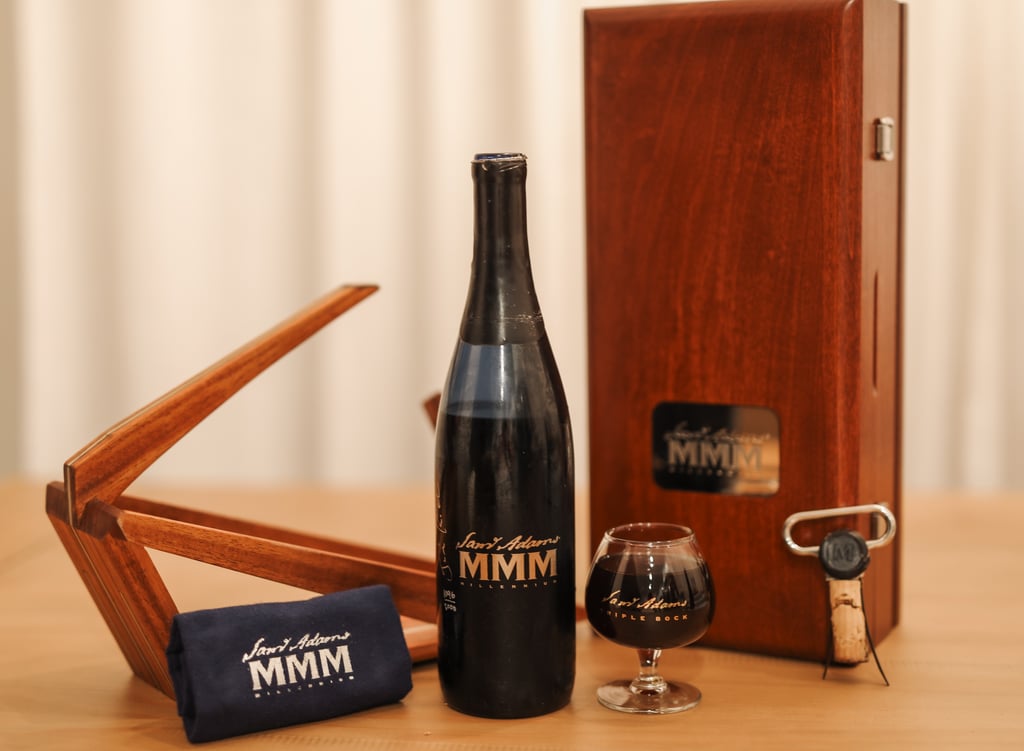
Inside, the sleek cobalt blue bottle rested against its bed of deep blue felt, the interior contrasting beautifully with the warm color of the wood surrounding it. It became evident immediately that this was never intended to be “just another beer.” We carefully lifted the bottle out, removing the accompanying blue felt bag, which was complete with a silver-foil “MMM” monogram matching the bottle itself. As with every bottle produced, Jim Koch’s signature stretched down the side, and both the bottle and presentation box were hand-numbered 1096/3000. A natural cork, sealed beneath black wax and stamped with a single silver “M,” completed a presentation that remains every bit as impactful today as it must have been in 1999.
Before a single drop had even been poured, Millennium had already accomplished something. It reminded us how much anticipation could be built around opening a single bottle of beer.
Prep & Extraction
For Millennium, we knew preparation was just as important as the tasting itself.
From the moment the bottle arrived, it was laid on its side in a wine fridge maintained right around 55°F, allowing it to rest under ideal cellar conditions. Forty-eight hours before the tasting, the bottle was carefully stood upright in the refrigerator, giving nearly three decades’ worth of sediment ample time to settle back to the bottom before the first pour. Opening the bottle would prove to be an occasion in itself.
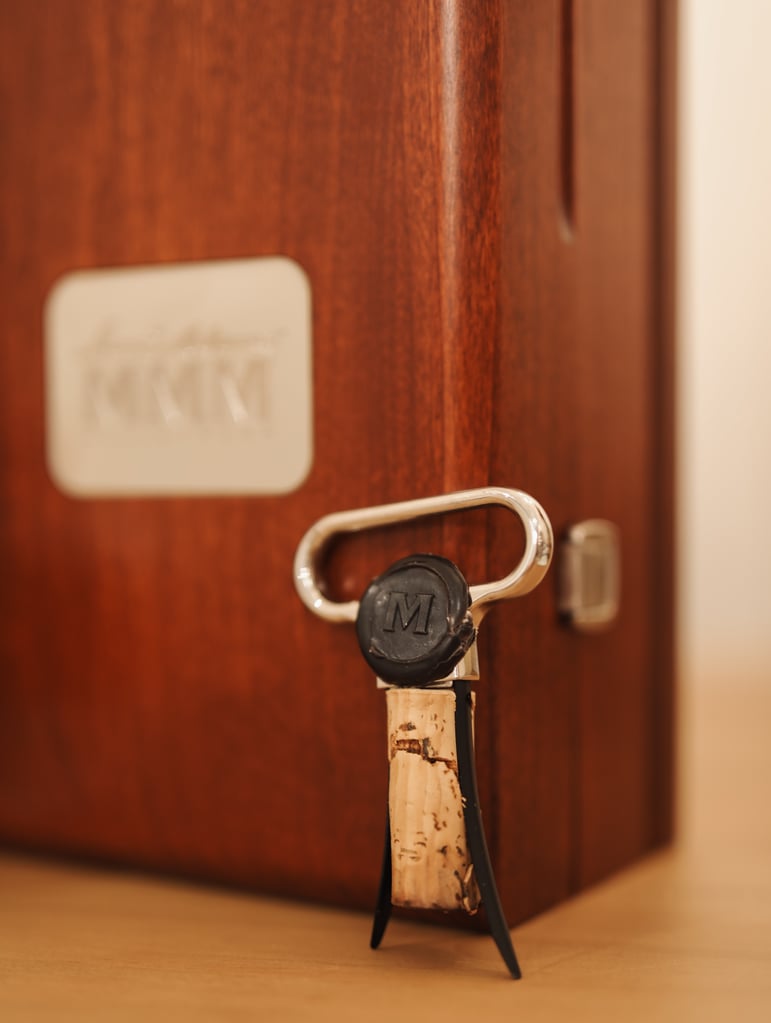
Rather than immediately reaching for a traditional corkscrew, we opted first for an Ah-So, also known as a Butler’s Friend—a two-pronged cork extractor designed specifically for fragile, aged corks. Unlike a corkscrew, the Ah-So gently slides between the cork and the neck of the bottle, allowing the cork to be twisted free without piercing its delicate structure.
After carefully trimming away the black wax and underlying foil, the cork was finally revealed. The Ah-So initially seemed promising, but as the prongs worked their way deeper into the neck, the cork began to slide downward rather than upward. After a series of careful twists and gentle pulls, roughly half of the cork emerged before its age finally caught up with it. The softened cork broke in half.
Fortunately, patience won out as we switched to our waiter’s corkscrew and carefully threaded it into the remaining section. Thankfully, the rest of the cork was removed cleanly without introducing any fragments into the bottle. For the first time in nearly twenty-seven years, Millennium met fresh air.
The cork slipped out silently, showing no evidence of any remaining carbonation. There was only quiet anticipation and the unmistakable aroma of a beer that had patiently waited almost three decades to be enjoyed.
The Liquid
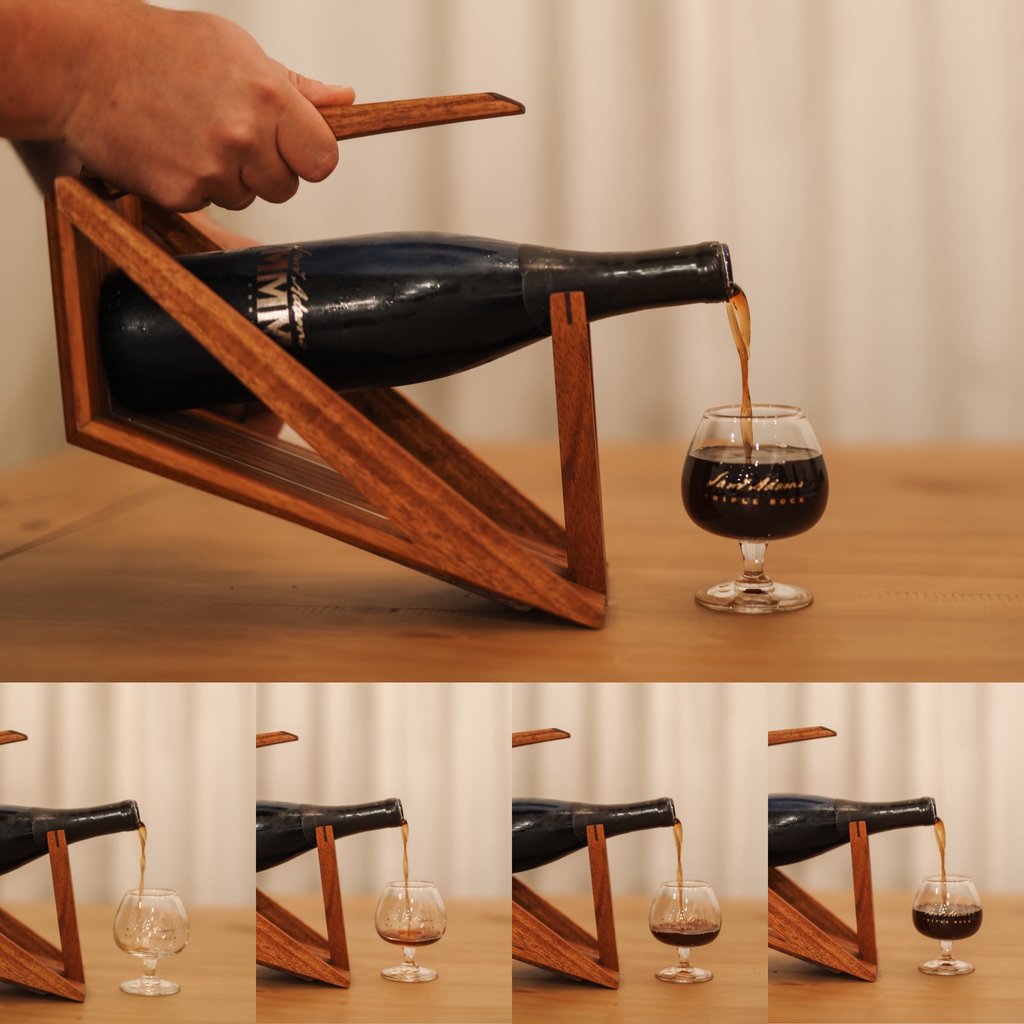
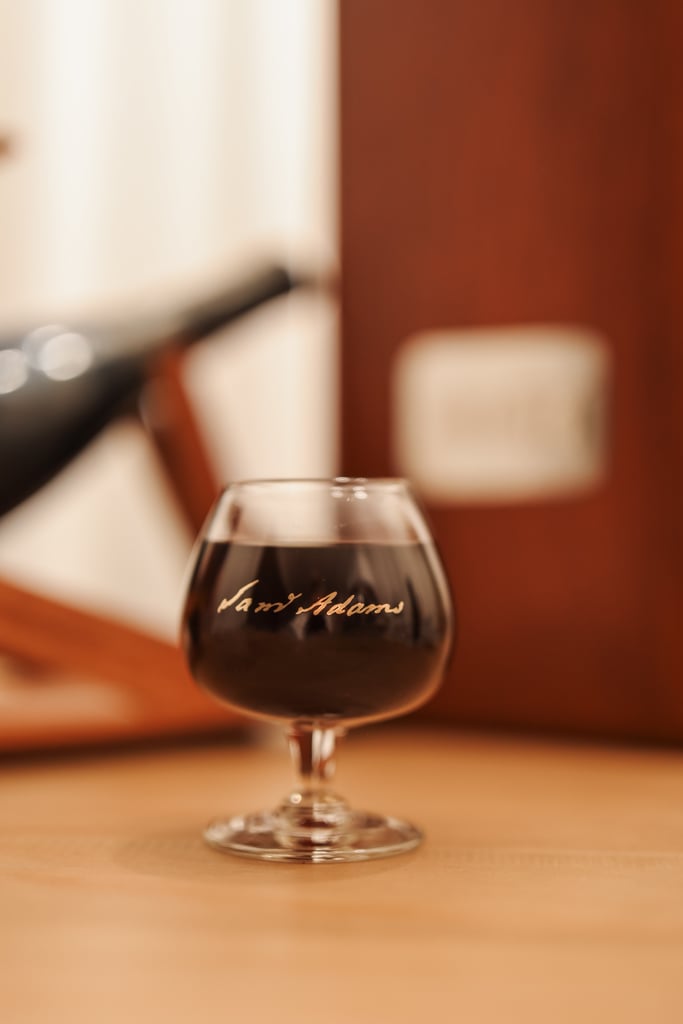
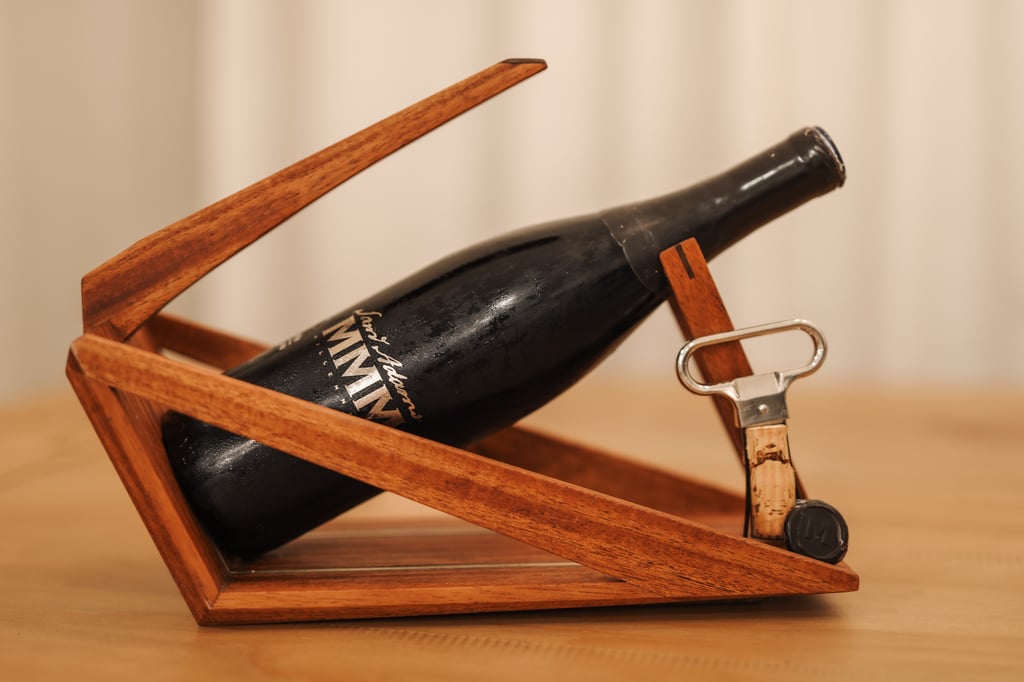
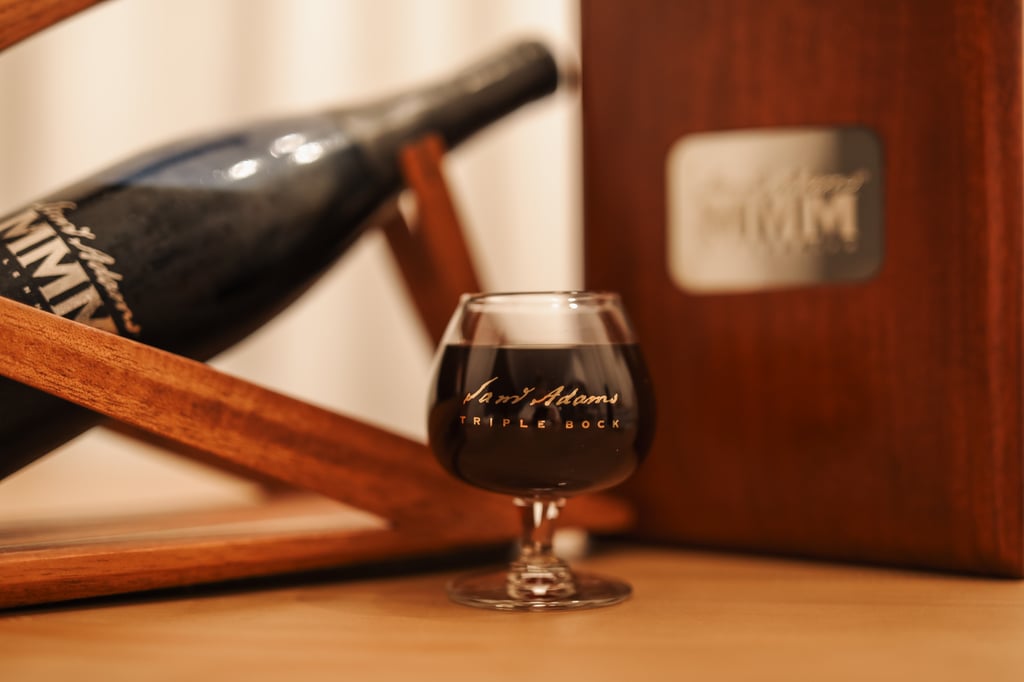
To ensure that the liquid poured clear, the bottle was transferred into a beautiful, handmade Soren lambic cradle so the sediment on the bottom remained undisturbed. The result couldn’t have been better. Millennium flowed from the bottle with remarkable clarity, cascading into our hand-selected Triple Bock snifter in a deep crimson stream. Semi-translucent with brilliant ruby highlights, the beer settled perfectly still. A gentle swirl of the glass revealed slow-moving legs, the Gibbs-Marangoni effect reminding us that this was a beer unlike almost any other ever brewed.
The aroma is immediately comparable to a vintage Madeira. It opens with toasted walnut, natural wood and a soft, herbaceous character that layers into notes of Earl Grey tea and roasted grain. With time in the glass, the profile becomes increasingly complex. Delicate umami notes emerge alongside a restrained floral bitterness, while an unmistakable oxidative character contributes even more depth. Those familiar with traditional Chinese baijiu may even recognize some similarities in Millennium’s uniquely layered aromatics, a surprising but welcome comparison that speaks to its extraordinary evolution over time.
Then comes the moment every collector wonders about…the first sip.
While the palate does well to confirm what the nose suggested, it also provides a distinctly deeper character, adding another layer to the experience. Where the aroma leans firmly toward oxidative complexity, the palate showcases a beer that remains remarkably expressive. Sweetness arrives first, quickly balanced by layers of dried fruit, candied orange peel and burnt almond. It simultaneously rides the line between dry and rich, fruity yet herbaceous. Each sip provides another subtle layer.
Perhaps the most captivating characteristic, however, is something far more difficult to describe. There is an unmistakable essence of dried leaves, an autumnal, nostalgic quality that lends an earthy minerality to the beer. It’s a note that feels less like a flavor and more like a memory, grounding the beer beneath its sweetness and alcohol content.
As those deeper layers gradually fade and time in the glass plays its part, Millennium offers what may be its closest connection to youth. The profile mellows and sweetens, with lingering notes of stewed raisin, brown sugar, dark chocolate and deeply caramelized malt remaining on the finish. Together, they offer a glimpse into what this extraordinary beer may have tasted like decades earlier.
Completely still after twenty-six years, Millennium’s lack of carbonation adds to the illusion that this transcends beer. Beyond that, the slightly slick mouthfeel and medium body further help make the experience feel strikingly similar to a fortified wine or vintage Madeira. And even with its 20.9% ABV, the alcohol is beautifully integrated, contributing warmth without boozy aggression. The finish is exceptionally long, carrying gentle bitterness alongside layers of lingering caramelized malt and oxidized fruit.
There is, of course, no way of knowing how closely Millennium still compares to what Jim Koch envisioned when it was bottled in 1999. Time changes every beer differently. Yet perhaps that uncertainty was always part of the experiment. This experience was never simply about opening a rare bottle. It was about witnessing the passage of time through one of craft beer’s most ambitious creations. Some beers are remembered because they’re rare. Others are remembered because they changed beer forever. Millennium deserves to be remembered for both.
Millennium’s Legacy
Millennium’s influence has largely been taken for granted, often without people even realizing it. High-ABV barrel-aged beers, limited boxed releases, specialty numbered vintages, waxed bottles and high price tags are all relatively commonplace in today’s market. Breweries regularly encourage drinkers to cellar their releases and come up with monstrous recipes heavily influenced by the casks in which they spent time aging. Millennium anticipated much of what followed.
That being said, Samuel Adams wasn’t the sole brewery responsible for elevating today’s beer market, nor was it the first to challenge convention. But Millennium became one of the earliest and most visible examples of a brewery asking consumers to rethink what beer could be. It rewarded patience and made a powerful case for craftsmanship over volume. And perhaps most importantly, it redefined how beer could be presented and the category in which it could compete.
Its influence can still be traced through Samuel Adams’ own lineage. Without Triple Bock, there is likely no Millennium. Without Millennium, it’s hard to imagine Utopias taking the form it eventually would. But these ripple effects extend far beyond Boston Beer. Today’s entire culture of whale releases, cellared vertical shares and contemplative expressions of beer all owe something to the pioneers who were willing to ignore the preexisting standards.
It’s ironic, really. As craft beer has become increasingly obsessed with what’s new, many of the beers that shaped the industry have quietly slipped from memory. Thankfully, there have been signs that appreciation for brewing history is beginning to return. Across the country, breweries are reviving classic recipes, celebrating anniversaries with faithful recreations and embracing styles that helped build American craft beer instead of just chasing the next trend. Even beer festivals have increasingly carved out spaces for vintage and “rare beer” tastings and cellar-aged bottles, while collectors continue opening beers that at one point were thought too valuable to ever drink. And it’s not just out of curiosity, but to help preserve the stories they represent.
Maybe that is Millennium’s greatest lesson of all.
Beer doesn’t become legendary just because it’s rare. It becomes legendary because it challenges what can be done. Long after the bottles are opened, the ideas behind them remain. Millennium was never just a celebration of the year 2000. It was, and always will be, a statement about possibility. Now, more than a quarter-century later, that statement still resonates.




Conversations (0)
No comments yet.